5,084 yards and 48 touchdown passes once sounded like numbers from another sport. Dan Marino put them up in 1984, long before the NFL became a quarterback league in the modern sense, and that season still sits at the center of his story. But the full arc is bigger than one record year: a Pittsburgh kid with a fast release, a first-round slide that changed Miami history, 17 seasons with one franchise, and a post-football life shaped as much by family and advocacy as by passing records.
From Pittsburgh playgrounds to a major choice
Daniel Constantine Marino Jr. was born on September 15, 1961, in Pittsburgh, Pennsylvania. Football was close at hand early. His father, Daniel Marino Sr., coached his grade-school team, and Marino later traced part of his trademark quick release to those early lessons.
At Central Catholic High School in Pittsburgh, he was more than a promising quarterback. He was enough of an all-around athlete that the Kansas City Royals selected him in the fourth round of the 1979 MLB Draft. He chose football instead, a decision that sent him toward Pitt and, eventually, the Miami Dolphins.
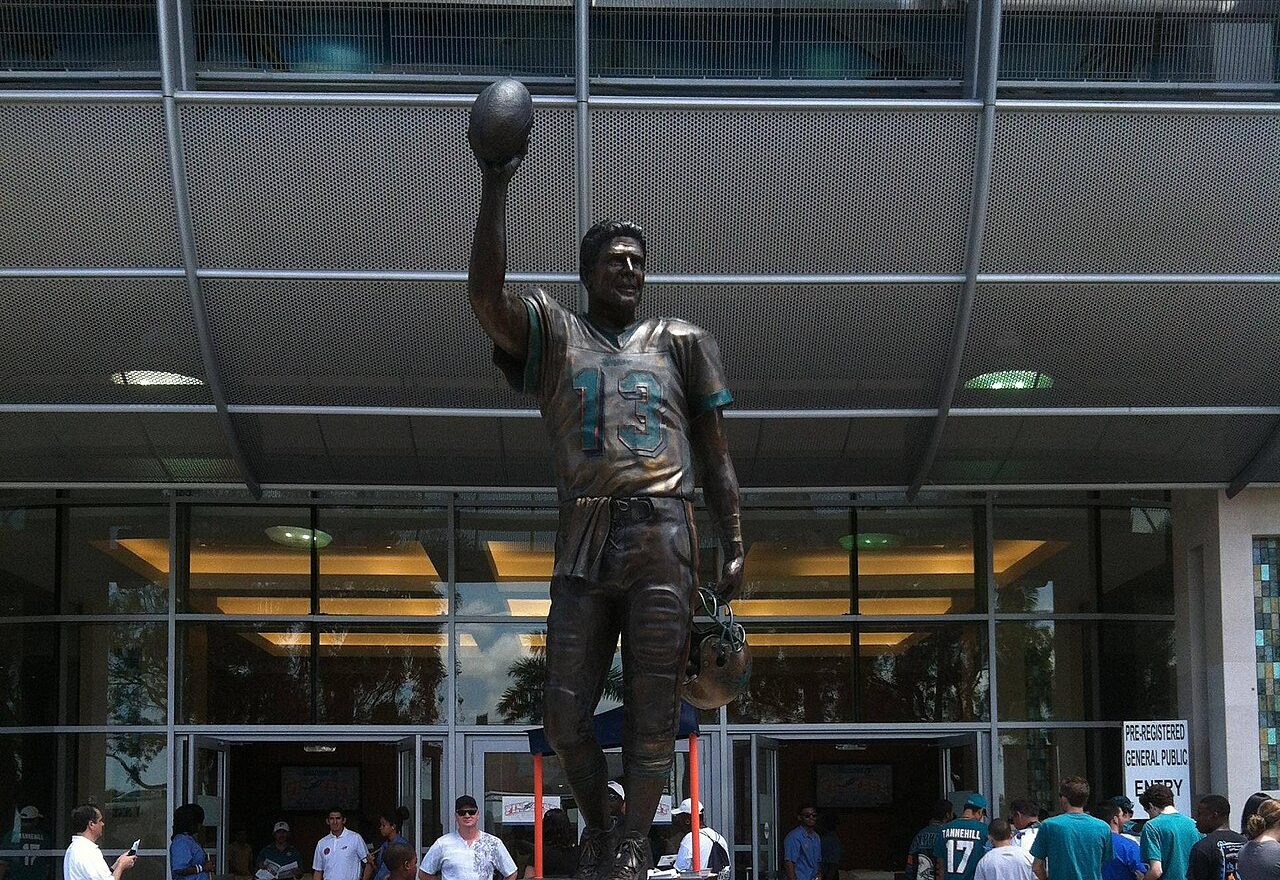
That familiar No. 13 started to gather meaning early. Central Catholic later retired it, and so did Pitt and Miami, an unusual link across every major stop in his career.
Pitt made him a national name
Marino stayed home for college and played at the University of Pittsburgh from 1979 through 1982. Pitt was one of the country’s strongest programs at the time, and he stepped into a setting where big expectations were normal.
He was part of Pitt’s 1979 team that beat Arizona in the Fiesta Bowl, though as a freshman he was not yet the featured starter. By the time his college career matured, his game already looked familiar: a strong arm, quick decisions, and the confidence to challenge tight coverage. In 1981, he earned first-team All-American honors.
His final college season was more uneven than many expected, and that mattered when the draft arrived. Even so, Marino had done enough to establish himself as one of the most talented quarterbacks in the country. Pitt later retired his No. 13, and he was inducted into the College Football Hall of Fame in 2003.
The draft slide that became Miami’s gain
The 1983 NFL Draft is still remembered for quarterbacks, and Marino’s path through it remains one of the enduring twists. He was selected by the Dolphins with the 27th overall pick in the first round, behind several other passers in a class that included John Elway, Jim Kelly, and Jim McMahon.
Miami got a franchise quarterback almost by accident. Marino did not open his rookie season as the starter, but he quickly forced the issue. In 11 games, with nine starts, he threw 20 touchdown passes and made the Pro Bowl. It was an immediate sign that Don Shula’s offense had changed shape.
That early version of Marino already looked distinct. He was not a scrambler and did not need to be. The ball came out quickly, often before pass rushers could finish their move, and he had the arm strength to attack every part of the field.
The season that reset the scale
Some careers have one year that becomes shorthand. For Dan Marino, it is 1984.
In his second NFL season, he completed 362 passes for 5,084 yards and 48 touchdowns, with 17 interceptions. He won the league MVP award and Offensive Player of the Year. More important than the trophies was the shock of the production. No quarterback had ever thrown for 5,000 yards in a season before. No one had reached 40 touchdown passes, either.
Those numbers came in a very different passing era, which is why they still carry weight. Marino was not just leading the league; he was dragging the standard forward.
Miami went 14-2 and reached Super Bowl XIX. The Dolphins beat Seattle in the divisional round and Pittsburgh in the AFC Championship Game before losing to Joe Montana and the San Francisco 49ers in the Super Bowl. It would be Marino’s only trip to the game, a fact that has always hovered around his legacy because so much else on his résumé looks championship-caliber.
Seventeen years, one franchise
Marino spent his entire NFL career with the Dolphins, from 1983 through 1999. That kind of one-team career is rare for a quarterback of his stature, and it became part of his identity. In Miami, he was not just the starter. He was the franchise’s defining offensive player.
The honors came in waves. He was selected to nine Pro Bowls and was a first-team All-Pro three times. Across 242 regular-season games, he completed 4,967 passes for 61,361 yards and 420 touchdowns, with 252 interceptions. His career completion rate was 59.4 percent, and he finished with a 147-93 record as a starter in the regular season.
By the time he retired, the record book was crowded with his name. Marino became the first quarterback to throw for 50,000 career passing yards, the first to reach 60,000, and the first to hit 400 touchdown passes. At retirement, he held or shared 25 NFL regular-season records.
The path was not perfectly smooth. He tore his Achilles tendon early in the 1993 season, a major injury at a time when recovery was less routine than it is now. His return in 1994 was one of the better comeback stories of his career. He threw for 4,453 yards and won NFL Comeback Player of the Year, reminding everyone that his game had never depended on mobility.
Miami reached the playoffs 10 times during his career, but the missing Super Bowl title remained the obvious gap. That absence has long fueled debate around where he belongs among the greatest quarterbacks. The numbers, the influence on passing offense, and the longevity made his case strong anyway.
He retired after the 1999 season. The ending was abrupt and difficult, Miami’s final game of that year was a lopsided playoff loss in Jacksonville, but it did little to alter the larger picture. The Dolphins retired No. 13, and the team’s connection to him has remained close ever since.
Why his game still stands out
Marino’s style aged well because it was built on traits that work in any era. The quick release is the first thing people remember. He could generate velocity without a long motion, which gave defenders less time to react and often made protection look better than it was.
Then there was the pocket command. He read coverages quickly, trusted what he saw, and was willing to throw into narrow windows. He was also one of the clearest examples of a quarterback who could change a game without leaving the pocket. Long before spread concepts and inflated passing totals became common, he was producing like a modern high-volume passer.
That is a big reason his 1984 season still gets revisited whenever fans talk about the best quarterback seasons ever. It was not just productive. It was ahead of its surroundings.
The Hall of Fame call came in 2005, his first year of eligibility. For a player with Marino’s place in league history, there was little suspense.
Family, business, and the work that lasted
Away from football, Marino’s life has long centered on family and charitable work. He married Claire Veazey in 1985, and they have six children. Their son Michael’s autism diagnosis helped shape the next major chapter of Marino’s public life.
In 1992, he founded the Dan Marino Foundation, focused on children and young adults with autism and other developmental disabilities. He also played a key role in the Dan Marino Center, now part of Nicklaus Children’s Hospital in South Florida. If his on-field legacy is tied to passing records, his off-field identity is closely tied to that work.
That broader impact was recognized in 1998, when he received the Walter Payton NFL Man of the Year award.
His post-playing years have also included business ventures and media appearances. Marino has been involved with several companies and partnerships, including Anthony’s Coal Fired Pizza and other South Florida business interests. Not every investment worked. He reportedly lost millions in Digital Domain after the company went bankrupt, a reminder that a famous playing career does not guarantee easy wins in business.
He also drifted into pop culture in a way few quarterbacks do. There was a memorable appearance in Ace Ventura: Pet Detective, and he has remained a familiar figure in endorsements and Dolphins-related roles.
One private-life matter should be handled carefully. Multiple published reports, including reporting by the New York Post in 2013, said Marino acknowledged fathering a child with CBS production assistant Donna Savattere and providing financial support. Because this concerns private family life, it is best described as publicly reported rather than expanded beyond established coverage.
Still tied to Miami
Retirement did not really separate Marino from the Dolphins. He has remained connected to the organization in advisory roles, and his public presence in South Florida still feels natural rather than ceremonial.
That fits the shape of his career. He spent 17 seasons with one team, wore one number, and became one of the rare quarterbacks whose name is almost inseparable from his franchise. For many fans, Dan Marino is still the image of the Miami Dolphins quarterback.
FAQ
When was Dan Marino born?
He was born on September 15, 1961.
What team did Dan Marino play for?
He played his entire NFL career for the Miami Dolphins, from 1983 through 1999.
Did Dan Marino win a Super Bowl?
No. He reached one Super Bowl, XIX, after the 1984 season, and Miami lost to San Francisco.
How many passing yards and touchdowns did Dan Marino have?
He finished with 61,361 passing yards and 420 touchdown passes in the regular season.
When was Dan Marino inducted into the Hall of Fame?
He entered the Pro Football Hall of Fame in 2005.
What is Dan Marino doing now?
He has remained involved with the Dolphins in advisory work and continues to be associated with the Dan Marino Foundation.
Photo: Jg772010, CC BY-SA 4.0, via Wikimedia Commons