Four hundred twenty-two passing yards in an NFL debut tends to get people’s attention. Cam Newton did that in his first game, then followed it with another 400-yard performance the next week, announcing himself as something more than a typical No. 1 pick.
That had been the pattern for much of his football life. Cameron Jerrell Newton, born May 11, 1989, in Atlanta, Georgia, was a blue-chip recruit, took a winding route through college, won a national title and the Heisman Trophy at Auburn, then became the first overall pick in the 2011 NFL Draft. At his best with the Carolina Panthers, he was an MVP, a Super Bowl quarterback, and one of the most productive runners the position has produced.
At 6-foot-5 and around 245 pounds during his playing career, Newton never fit neatly into old quarterback categories. He was too big to be described only as elusive, too mobile to be called a pocket passer, and too central to the run game to be compared cleanly with most of his peers.
Growing up in a football family
Football was close to home long before Newton became a national name. His father, Cecil Newton Sr., played briefly in the NFL, and his brothers also built football careers: Cecil Newton became an NFL center, while Caylin Newton played quarterback at Howard.
At Westlake High School in Atlanta, Newton developed into one of the country’s top recruits. Rivals rated him a five-star prospect and one of the best dual-threat quarterbacks in his class. Even then, that label only partly explained him. He could run, certainly, but what set him apart was the combination of size, arm strength, and the ease with which he could overwhelm a game physically.
He also played baseball and basketball as a younger athlete. Newton later joked that he left baseball because he did not like being hit by the ball and moved away from basketball because of foul trouble. The stories stuck because they matched the larger image: a gifted athlete who was always going to end up on a football field.
A college path that doubled back before it took off
Newton’s college career did not move in a straight line.
He began at Florida, where he spent the 2007 and 2008 seasons backing up Tim Tebow on loaded Urban Meyer teams. His time there ended after a November 2008 arrest in connection with a stolen laptop. Newton later completed a pre-trial diversion program, and the felony charges were dropped. Around that same period, Fox Sports reported that academic issues also played a role in his departure from Florida; that reporting has long been part of the public record, but it should be treated as reported, not as an established finding in the same way as the arrest.
From Florida, he went to Blinn College in Texas in 2009. That stop became the reset point in his football story. Newton led Blinn to the NJCAA national championship and rebuilt his reputation on the field, showing the same big-play ability that had made him such a coveted recruit in the first place.
Then came Auburn, and with it one of the most decorated single seasons a college quarterback has had.
In 2010, Newton led Auburn to a 14-0 season and a win in the BCS National Championship Game for the 2010 season. He won the Heisman Trophy, the Maxwell Award, the Walter Camp Award, AP College Player of the Year, and SEC Offensive Player of the Year. Statistically, the season was just as striking: 2,854 passing yards, 30 touchdown passes, 1,473 rushing yards, and 20 rushing touchdowns. He became the first player in major college football history to pass for 20 touchdowns and rush for 20 touchdowns in the same season.
That Auburn rise was not free of controversy. During Newton’s recruitment, allegations surfaced that his father had sought money from Mississippi State during the recruiting process. Those claims were widely reported at the time, and the NCAA later ruled Newton eligible while finding no evidence that Auburn or Newton knew of any pay-for-play arrangement. It remains an important part of the public story around his transfer, but it should be described carefully as an allegation and NCAA matter, not broadened beyond the documented reporting.
One quieter detail rounded out the picture later: Newton returned to finish his degree, graduating from Auburn in sociology.
The first overall pick, and an immediate jolt in Carolina
The Panthers selected Newton with the No. 1 overall pick in the 2011 draft. He signed a four-year, fully guaranteed rookie contract that July, and the pressure attached to that draft slot arrived with him.
It did not take long for him to answer it.
In his first NFL game, against Arizona, Newton threw for 422 yards, the most ever by a rookie in his debut at the time. A week later he threw for 432 against Green Bay. Through two games, he had 854 passing yards, another rookie record.
By the end of that first season, he had thrown for 4,051 yards, becoming the first rookie quarterback in NFL history to pass for more than 4,000 in a season. He also ran for 706 yards and 14 touchdowns, setting a single-season record for rushing touchdowns by a quarterback at the time. The league named him Offensive Rookie of the Year, and he made the Pro Bowl.
The early version of Newton was already clear: a quarterback who could stress defenses in every direction, especially near the goal line, where Carolina often used his size as a power element rather than a change-up.
Carolina’s centerpiece and the 2015 peak
Newton’s first stint with the Panthers ran from 2011 through 2019, and it remains the core of his NFL identity. He became the face of the franchise, the engine of its offense, and the player around whom Carolina built everything.
The high point came in 2015.
That season, Newton threw for 3,837 yards and 35 touchdowns, ran for 636 yards and 10 more scores, and led Carolina to a 15-1 record. He was named NFL MVP, Offensive Player of the Year, first-team All-Pro, and earned another Pro Bowl selection. The Panthers reached Super Bowl 50 before losing to the Denver Broncos.
His performance in the NFC Championship Game against Arizona captured the full version of his game: 335 passing yards, two touchdown passes, two rushing touchdowns, and complete control of the night.
Newton’s 2015 season also made history in a more specific way. He became the first player in NFL history to throw at least 30 touchdown passes and rush for at least 10 touchdowns in the same season. For a modern dual-threat quarterback, that stat line still stands as one of the clearest examples of how unusual he was.
Across his Carolina years, he piled up franchise marks and changed the shape of the offense. He left the Panthers as the team’s all-time leader in passing yards, passing touchdowns, completions, and attempts. He was not simply a quarterback who happened to run. The run game was built around him, especially in short-yardage and red-zone situations, where his size made him one of the league’s hardest players to account for.
Injuries, New England, and one last return
As Newton’s career moved deeper into the decade, the physical toll became harder to ignore. Shoulder and foot injuries affected his play, especially late in his first Panthers run. Carolina released him in 2020, closing one chapter that had once seemed likely to last much longer.
He signed with the New England Patriots before the 2020 season and started 15 games there. The year was uneven, but it was also revealing. In a very different offense, and without the explosive supporting cast he had often enjoyed in Carolina’s best years, Newton still remained a major factor as a runner. He scored 12 rushing touchdowns for New England, a franchise record for a quarterback.
In 2021, he returned to Carolina for a brief second stint. The comeback produced a memorable moment almost immediately, when he scored and shouted, “I’m back,” a line that fit both the drama and self-awareness that had long surrounded him. It turned out to be his final NFL season.
Newton’s career totals: 32,382 passing yards, 194 touchdown passes, 123 interceptions, 5,628 rushing yards, and 75 rushing touchdowns. For years he held the NFL record for career rushing touchdowns by a quarterback; that mark was later surpassed, but the total still captures how central his running ability was to his game.
What made Cam Newton different
A lot of quarterbacks have been mobile. Very few have been built like Newton.
He played with the frame of a tight end or edge player, the running power of a short-yardage back, and the responsibilities of a franchise passer. In his best seasons, Carolina could call designed quarterback runs in obvious situations and still trust him to throw vertically outside the numbers. That combination forced defenses into compromises.
He was not a perfect passer, and accuracy came and went at points in his career. But reducing him to athleticism misses the point. Newton had a powerful arm, could create explosive plays when structure broke down, and handled an unusually large share of the offense. The Panthers asked him to do things most teams would never ask of their quarterback near the goal line, and for several seasons he made that approach work at a very high level.
That is why his résumé stands out. He was a Heisman winner, a first overall pick, an NFL MVP, and a quarterback whose rushing production was not a side note but a defining feature of his success.
Off the field: family, business, and a very public persona
Away from football, Newton has long been a visible public figure, in part because he made himself one. His fashion choices, postgame outfits, and ease in front of cameras became part of his image almost as much as his on-field celebrations.
His family life has also drawn regular attention. Newton has several children, and published reports about his relationships have often become part of the public conversation around him. He was previously in a long-term relationship with Kia Proctor, and later was publicly linked to comedian and media personality Jasmin Brown. Reporting has also connected him to La Reina Shaw. Because details in this area can shift and are often sourced to interviews or celebrity coverage, it is best to treat specific relationship timelines and family updates as reported rather than present every claim as independently verified fact.
What is well established is that Newton has been active in business beyond football. His ventures have included the men’s fashion brand MADE by Cam Newton, the Fellaship restaurant and lounge in Atlanta, and media and production projects. He has also done charitable work through the Cam Newton Foundation, which has focused on youth programs and educational initiatives.
Even some of the smaller stories around him help fill out the profile. Newton has spoken often about lessons from his father, including the “five Ps”, “Proper Preparation Prevents Poor Performance”, and teammates have described his habit of handing out nicknames. Those details fit the broader picture of a player who always seemed intentional about presentation, leadership, and identity.
FAQ
How old is Cam Newton?
He was born on May 11, 1989.
What teams did Cam Newton play for?
He played for the Carolina Panthers, then the New England Patriots, and then returned to Carolina.
Did Cam Newton win a Super Bowl?
No. He led the Panthers to Super Bowl 50, but Carolina lost to the Denver Broncos.
Was Cam Newton the first overall pick?
Yes. The Panthers selected him No. 1 overall in the 2011 NFL Draft.
What are Cam Newton’s career stats?
He finished with 32,382 passing yards, 194 passing touchdowns, 5,628 rushing yards, and 75 rushing touchdowns.
Did Cam Newton win the Heisman Trophy and NFL MVP?
Yes. He won the Heisman at Auburn for the 2010 season and the NFL MVP for the 2015 season.
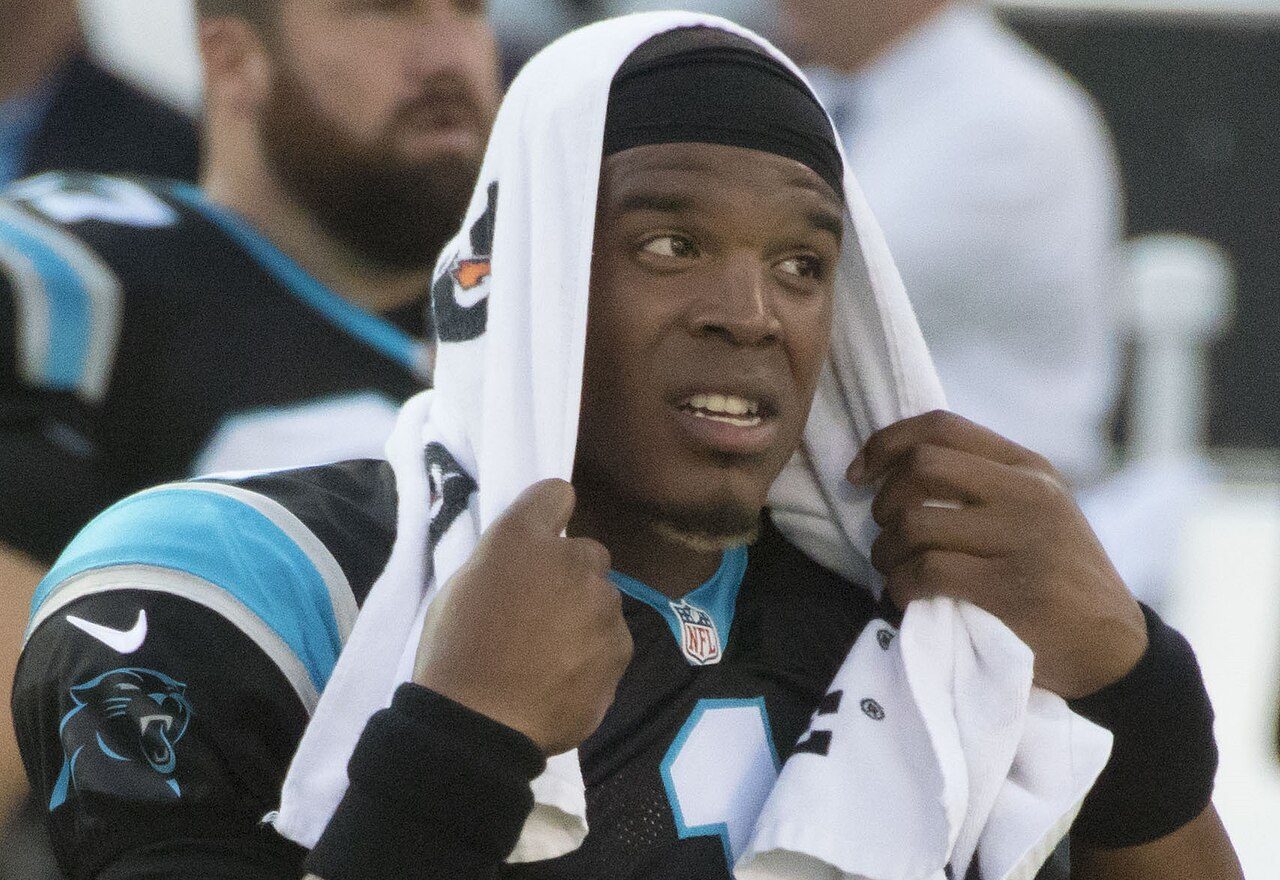
Photo: Keith Allison, CC BY-SA 2.0, via Wikimedia Commons