Pick No. 102 rarely comes with this much staying power. Kirk Cousins entered the league as a fourth-round selection in 2012, arrived without first-round fanfare, and still built one of the more durable quarterback careers of his era through accuracy, availability and a steady command of the position.
That path has taken him from Michigan to Washington, then to Minnesota and Atlanta. Along the way, he became one of the NFL’s most productive passers, a quarterback whose numbers often spoke louder than his public image. He has never been defined by improvisational chaos or celebrity flash. Instead, his career has been built on timing throws, pre-snap discipline and a willingness to keep doing the routine parts of the job well.
From Illinois to Holland, Michigan
Kirk Daniel Cousins was born on August 19, 1988, in Barrington, Illinois, and grew up in Holland, Michigan. At Holland Christian High School, he was not just a football player. He also played baseball and basketball, which fits the broader picture of an athlete who developed coordination and competitiveness across sports before football became the center of his career.
As a high school quarterback, he put up 3,204 passing yards, 40 touchdowns and 18 interceptions. Those numbers were good enough to draw college interest, though not the kind of national attention that turns a teenager into a blue-chip celebrity. His rise was more gradual than that, which would become a theme.
Michigan State and a bigger stage
Cousins arrived at Michigan State in 2007 and redshirted his first season. By the time he became the starter, the Spartans had a quarterback who fit their program well: organized, tough and efficient.
He started from 2009 through 2011 and helped lead Michigan State through one of its stronger stretches of that period. In 2010, the Spartans shared the Big Ten title. In 2011, they reached the inaugural Big Ten Championship Game. Cousins finished his college career with 9,131 passing yards, 66 touchdown passes and a reputation for poise in big spots.
There were honors, too. He was a second-team All-Big Ten selection in 2011, won the Senior CLASS Award, and became only the second three-time captain in school history. One detail that still follows him in East Lansing is his 4-0 record against Michigan, the kind of rivalry note that tends to stick.
Off the field, he majored in kinesiology and was active with Athletes in Action, details that matched the public persona he would later carry into the NFL: deliberate, faith-oriented and highly structured.
Washington: drafted as a backup, developed into the starter
Washington selected Cousins in the fourth round of the 2012 NFL Draft, making him the 102nd overall pick. He entered a quarterback room that already included Robert Griffin III, so the early expectation was clear: Cousins would be depth, insurance and a developmental passer.
That changed over time.
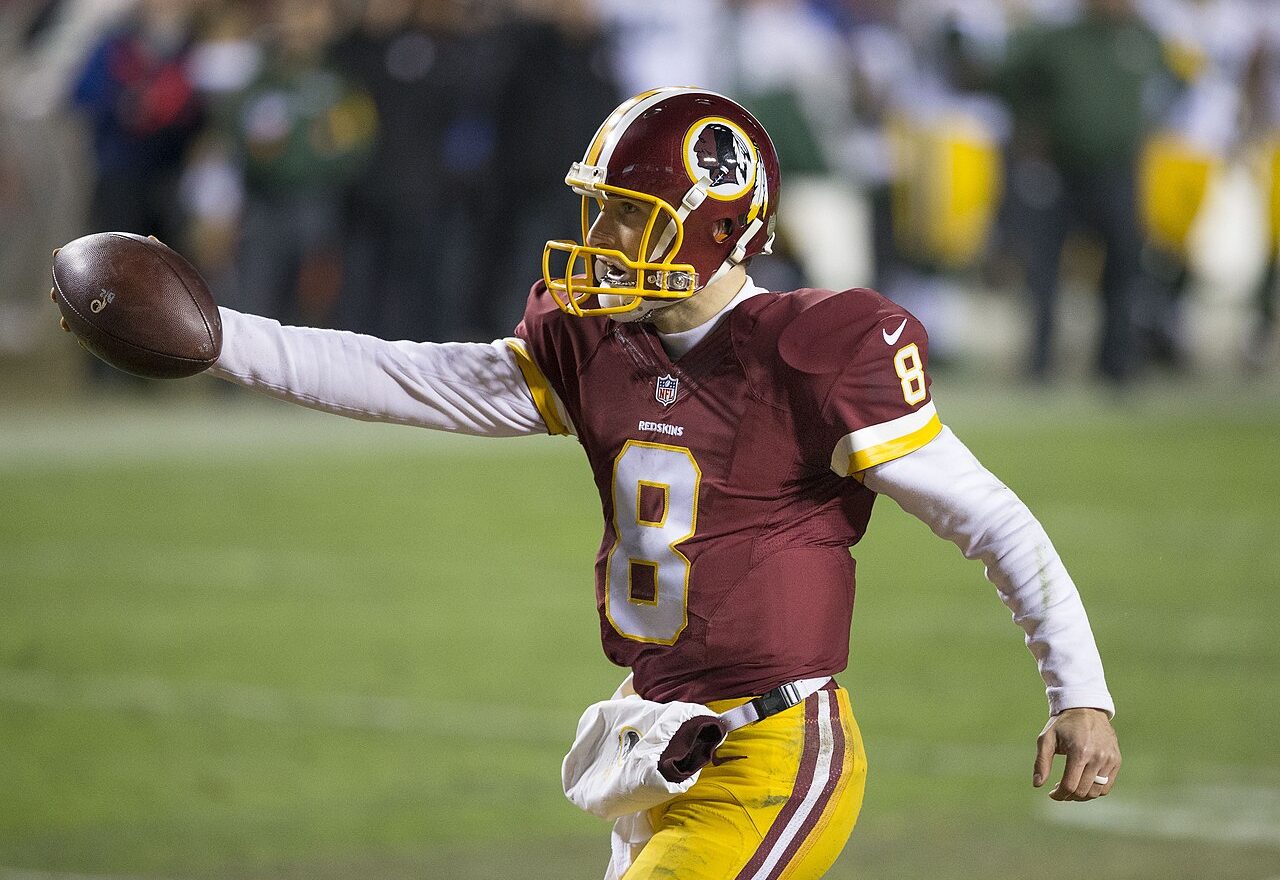
From 2012 through 2017, he moved from reserve duty into the starting job and became one of the more productive quarterbacks in franchise history. His breakout as a full-time starter came in the middle of that run. In 2015, he threw for 4,166 yards, 29 touchdowns and 11 interceptions while leading the league in completion percentage at 69.8. He followed that with an even bigger yardage season in 2016, passing for 4,917 yards with 25 touchdowns and 12 interceptions, and earned a Pro Bowl nod after that season.
By the end of his Washington tenure, he had set franchise single-season marks for passing yards, completions and completion percentage. More important for his career arc, he had established his market value. Washington used the franchise tag on him in 2016 and again in 2017, a rare sequence that kept him from long-term security in the short term but positioned him for a major payday later.
That stretch also shaped the way the league viewed him. He was not seen as a quarterback who would carry an offense through sheer athletic improvisation. He was seen as someone who could process quickly, throw accurately and keep an offense productive over 16 games.
Minnesota and the contract that changed the market
In March 2018, Cousins signed with the Minnesota Vikings on a three-year, $84 million fully guaranteed contract. At the time, it was the first fully guaranteed multi-year contract for a quarterback in NFL history, and it immediately became one of the defining business stories of the league.
The football fit was straightforward. Minnesota wanted a veteran passer who could stabilize a talented roster, and Cousins gave them exactly that for much of his run there.
Across six seasons with the Vikings, from 2018 through 2023, he produced at a high level and climbed near the top of several franchise passing lists. He made the Pro Bowl in 2019, 2021 and 2022, giving him four selections overall when combined with his Washington honor.
Some of his best work came in 2021 and 2022. In 2021, he threw 33 touchdown passes against just seven interceptions. In 2022, he passed for 4,547 yards and 29 touchdowns while helping Minnesota to a 13-4 record. That season also sharpened one of the more interesting parts of his reputation: for a quarterback often described as merely steady, he authored a long list of late-game rallies. He shares the NFL single-season record for fourth-quarter comebacks and game-winning drives, with eight in each category, set in 2022.
Minnesota repeatedly recommitted to him. He signed a two-year extension in 2020 and later agreed to a one-year extension that kept him under contract through the 2023 season. His final year there ended abruptly, though, when he suffered a torn Achilles in October 2023, cutting short another productive season.
Even with that injury, his Minnesota years reinforced the same central truth of his career: if healthy, he would give a team efficient passing, strong ball placement and a dependable weekly baseline.
Atlanta: a short stop after Minnesota
After hitting free agency again, Cousins signed with the Atlanta Falcons in March 2024. The deal was reported as four years and $180 million, with $100 million guaranteed.
That move made sense on paper. Atlanta wanted an experienced quarterback for a roster that believed it was ready to compete, and Cousins offered a proven veteran presence coming off his rehab from the Achilles injury.
But the Falcons chapter did not become a long one. The organization later shifted direction, and his time there was brief compared with his stops in Washington and Minnesota. Because roster situations and quarterback transitions can change quickly, it is better to frame that period simply: Atlanta invested in him as a veteran answer, then moved on sooner than the contract initially suggested.
Career production and how he played
Cousins’ career numbers place him firmly among the most productive passers of his generation. Through his established body of work in Washington, Minnesota and Atlanta, he has consistently combined a high completion rate with strong touchdown production and relatively controlled interception totals.
His style has always been easy to identify. He wins with mechanics, timing and preparation. He is comfortable operating from the pocket, reading leverage and delivering accurately to the intermediate areas of the field. He is not a quarterback whose game depends on constant off-script creation, though he has enough mobility to move within the pocket and buy time when needed.
The statistical profile matches the tape. He has long ranked near the top of the league in completion percentage and passer rating, and those marks are not just the product of conservative football. At his best, he pushed the ball effectively off play-action, worked the middle of the field with confidence and punished coverage mistakes.
The playoff record has been a smaller part of the story. Cousins has one postseason win as a starter, including Minnesota’s overtime road victory at New Orleans after the 2019 season. That limited playoff résumé has often been part of the public debate around him, even as his regular-season efficiency remained strong over a long span.
Life away from football
A lot of Cousins’ off-field image has centered on how ordinary he has often seemed compared with the size of his contracts. He married Julie Hampton on June 28, 2014, and the couple have two sons. He proposed at the Speaker’s Balcony at the U.S. Capitol, a detail that became part of his public story early in his NFL career.
He has also spoken openly for years about his Christian faith, which has been a consistent part of his public identity since college. That faith-based side of his life also connects to his charitable work. He and his wife co-founded the Julie & Kirk Cousins Foundation, which supports families and youth through charitable initiatives.
Then there is the van. One of the most repeated personal details about Cousins is that he long drove an older conversion van despite earning franchise-quarterback money, a habit that fed his image as practical and unshowy and eventually became part of endorsement campaigns.
His endorsement work has included national and regional brands, though claims about exact net worth figures should be treated cautiously unless tied to verified financial reporting. Public estimates of athlete wealth are often approximate rather than definitive. The same goes for real-estate reports and relocation details, which are sometimes based on property listings and media reports rather than direct confirmation from the player.
The shape of his career
Few quarterbacks have done more to prove that draft position does not lock in a career ceiling. Cousins was not supposed to become one of the league’s major contract figures or one of its most statistically reliable long-term starters. He did both.
What defines his career is not one signature trait in isolation, but the accumulation of them: durability for most of his run, repeatable mechanics, careful decision-making, and enough production to keep teams investing in him. That combination made him valuable for a long time, even when the conversation around him never fully matched the consistency of the numbers.
FAQ
What college did Kirk Cousins attend?
He played college football at Michigan State.
When was Kirk Cousins drafted?
Washington selected him in the fourth round of the 2012 NFL Draft with the 102nd overall pick.
How many Pro Bowls has Kirk Cousins made?
He has been selected to four Pro Bowls.
What is Kirk Cousins known for as a quarterback?
He is known for accuracy, pocket passing, preparation and efficient production.
Who is Kirk Cousins’ wife?
He is married to Julie Hampton.
Did Kirk Cousins win a playoff game?
Yes. He won a playoff game with the Vikings after the 2019 season.
Photo: Keith Allison, CC BY-SA 2.0, via Wikimedia Commons