Six Super Bowl rings in New England would have been enough for most careers. Tom Brady left, changed conferences, won another one in Tampa, and turned a sixth-round draft slot into the longest, most productive quarterback run the NFL has seen.
Thomas Edward Patrick Brady Jr. was born on August 3, 1977, in San Mateo, California. Listed at 6-foot-4 and 225 pounds, the quarterback spent 23 seasons in the league, wore No. 12 for both the New England Patriots and Tampa Bay Buccaneers, and retired after the 2022 season with seven Super Bowl titles, 10 Super Bowl appearances, and a stack of passing records that reshaped the league’s record book.
A California kid with two paths
Long before Tom Brady became an NFL institution, he was a multi-sport standout at Junipero Serra High School in San Mateo. He graduated in 1995, and football was not his only serious option. The Montreal Expos selected him as a catcher in the 18th round of the 1995 MLB Draft, a useful reminder that his future was not yet locked to one sport.
There was ambition early, too. In a school essay, Brady wrote that he wanted to be a household name. It sounds almost too neat in hindsight, but it fits the drive that would define his career more than any stopwatch time or scouting report ever did.
Michigan: waiting, competing, finally taking over
His years at Michigan were anything but smooth. Brady arrived in 1995 and spent much of his college career fighting for snaps rather than cruising toward stardom. He has said he considered transferring during that stretch, and the thought makes sense given how crowded and uncertain the quarterback picture was.
When he finally got his chance, he made it count. Brady finished with a 20-5 record as a starter and helped Michigan win the 1999 Citrus Bowl and the 2000 Orange Bowl. He was an All-Big Ten honorable mention in 1998 and 1999 and served as a team captain as a senior.
That part of the story matters because it set the pattern for what came later. He was rarely the obvious choice at first. He kept hanging around until the job became his.
Off the field, he also spent the summers of 1998 and 1999 interning at Merrill Lynch, a small detail that later looked like an early sign of his interest in business beyond football.
Pick No. 199 and the start of the NFL climb
The image from the 2000 NFL Draft still follows him: Brady waiting far longer than elite quarterbacks are supposed to wait. The Patriots selected him in the sixth round with the 199th overall pick.
That draft position became part of his public identity because it never stopped being useful context. He entered the league with modest expectations, and his NFL Combine performance did little to change minds. The player who would later retire as the career leader in passing yards, completions, touchdown passes, regular-season wins, and playoff wins began as a developmental backup.
He played one game as a rookie in 2000. A year later, the course of league history changed.
New England: from injury replacement to dynasty quarterback
In 2001, Drew Bledsoe went down with an injury, and Brady stepped in. He led the Patriots to an 11-3 record as a starter in the regular season, then guided them through the playoffs and past the heavily favored St. Louis Rams in Super Bowl XXXVI. He was named Super Bowl MVP after completing 16 of 27 passes for 145 yards and leading the game-winning drive that set up Adam Vinatieri’s field goal.
That first title did not stand alone. New England won again in Super Bowl XXXVIII and Super Bowl XXXIX, and Brady was the MVP in the first two of those championship games. By the middle of the decade, the Patriots had become the league’s defining team, and their quarterback had become the calm center of it.
The next stage of his career added volume to the winning. In 2007, Brady threw 50 touchdown passes, won NFL MVP, and led New England to a 16-0 regular season. The Patriots did not finish the job in the Super Bowl, losing to the Giants, but that season marked a shift: he was no longer just the quarterback of a great system. He was one of the sport’s dominant players.
A torn ACL wiped out almost all of his 2008 season in Week 1. He returned in 2009, won Comeback Player of the Year, and kept the Patriots in contention. More honors followed: NFL MVP awards in 2010 and 2017, first-team All-Pro selections, and year after year of deep playoff runs.
Then came the second championship wave. New England beat Seattle in Super Bowl XLIX, rallied from 28-3 down against Atlanta in Super Bowl LI, and won again against the Rams in Super Bowl LIII. Brady was the Super Bowl MVP in XLIX and LI, giving him five for his career.
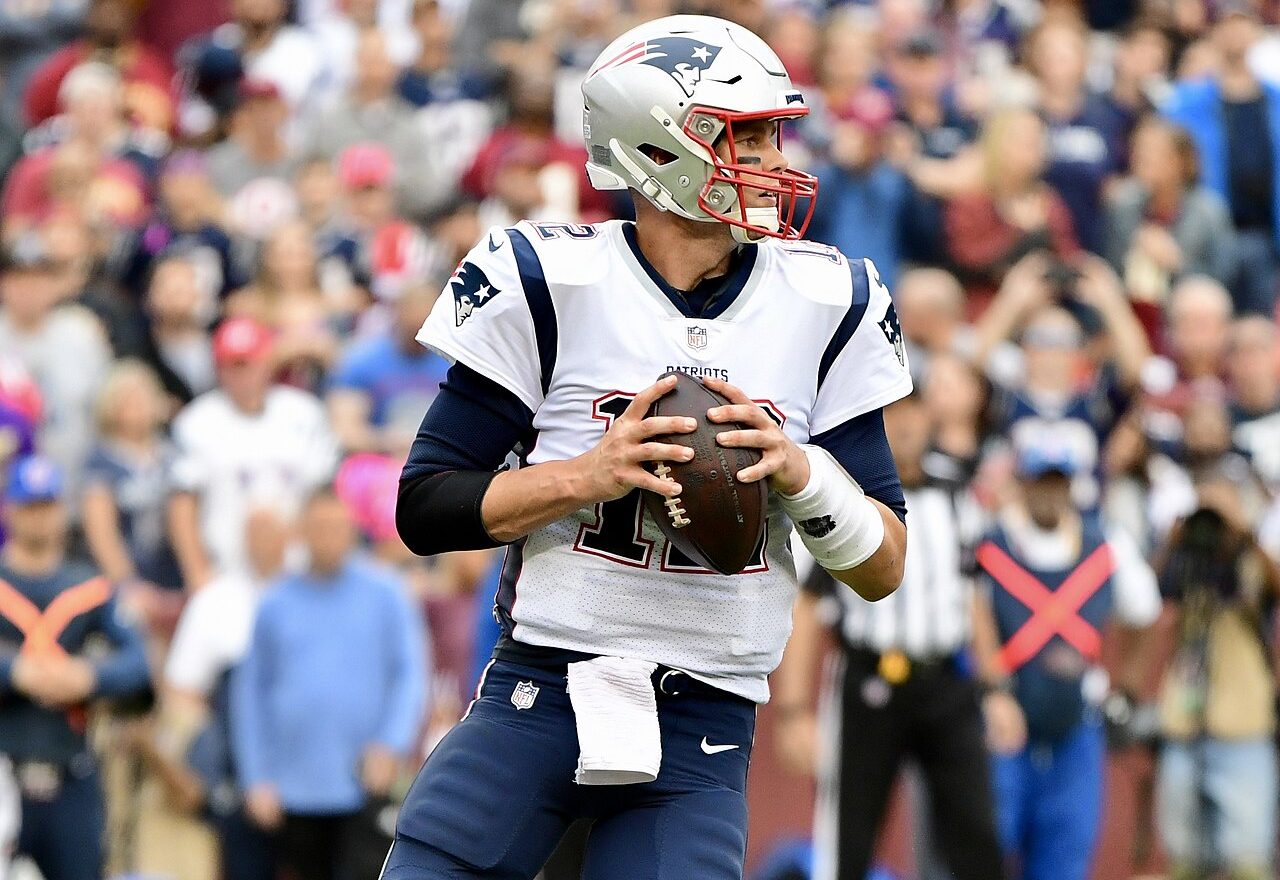
Across 20 seasons with the Patriots, he threw for 74,571 yards and 541 touchdown passes in the regular season. New England went 219-64 with him as a starter. The team won six Super Bowls with Brady at quarterback, and the partnership with Bill Belichick became one of the most successful coach-quarterback pairings in North American sports.
Deflategate and the most public controversy of his career
The biggest controversy attached to Brady’s name came during the 2014 postseason and spilled into the 2015 and 2016 seasons. In the case widely known as Deflategate, the NFL alleged that footballs used by the Patriots in the AFC Championship Game had been underinflated and that Brady was at least generally aware of the situation.
After a long appeals process, he served a four-game suspension to open the 2016 season. The case remains one of the most debated disciplinary episodes of his era. It should be described carefully: the league disciplined him, but the broader arguments around intent, evidence, and fairness never fully disappeared.
Tampa Bay: a late-career move that ended with another ring
After the 2019 season, Brady left New England and signed with the Tampa Bay Buccaneers. It was the first major change of scenery of his professional life, and it answered a question that had followed him for years: what would he look like away from the Patriots?
The answer came quickly. In his first season in Tampa, he threw 40 touchdown passes and led the Buccaneers to a Super Bowl LV win over the Kansas City Chiefs. Brady was named Super Bowl MVP for the fifth time after throwing for 201 yards and three touchdowns in the 31-9 victory.
That championship mattered for more than the count. It was his seventh, more than any single NFL franchise has won. It also made him the only player to win Super Bowl MVP with two different teams.
He played three seasons in Tampa, from 2020 through 2022, and added 14,643 passing yards and 108 touchdown passes there. His final season ended with a playoff loss to Dallas, and he announced his retirement in February 2023.
By then, his career totals in the regular season stood at 89,214 passing yards, 649 touchdown passes, 7,753 completions, and 251 regular-season wins as a starting quarterback. In the playoffs, he added 35 wins, 13,400 passing yards, and 88 touchdown passes. No quarterback has matched the full combination of longevity, production, and postseason success.
What made his game work
Brady was never sold as a quarterback built on rare movement or overwhelming arm talent. His game was about timing, pocket control, decision-making, and an unusual ability to stay composed when the game sped up around him.
He threw accurately to every area of the field, got the ball out quickly, and adjusted well before and after the snap. Teammates and coaches routinely pointed to preparation as one of his defining traits. So did opponents.
The late-game numbers support the reputation. He retired with the NFL records for fourth-quarter comebacks and game-winning drives in the regular season, and he also owns the playoff records for wins, starts, passing yards, and touchdown passes. Brady appeared in 10 Super Bowls, won seven, and was named Super Bowl MVP five times. Those are not style points. They are the cleanest explanation for why his career sits where it does.
Life away from football
His off-the-field profile grew almost as large as his football one. Brady was married to model Gisele Bündchen, and the couple divorced in 2022. Because it was widely reported and confirmed publicly, it belongs in the story; anything beyond that should be treated cautiously rather than turned into gossip.
Business became a major second act even before retirement. Brady co-founded TB12, the training and wellness company built around his fitness approach, and launched 199 Productions, a media company, in 2020. He was also involved with Autograph, a digital collectibles company, and became part of Religion of Sports.
Some of those ventures brought setbacks as well as visibility. Brady was a paid ambassador and reported equity holder for FTX before the company collapsed. That investment and endorsement tie became one of the more public business missteps linked to his post-playing profile.
He has also been involved in ownership and investment deals outside football. Those have included a minority stake in the WNBA’s Las Vegas Aces and a minority ownership role with English club Birmingham City, both widely reported moves that expanded his sports business footprint.
In broadcasting, Fox announced in 2022 that Brady had agreed to join the network as an analyst on a long-term contract after retirement. He eventually began that role after his playing career ended.
Brady has also done philanthropic work through the TB12 Foundation, which has supported athletes who need help accessing recovery and performance resources.
The scale of the résumé
The broad honors tell part of the story: three NFL MVP awards, two Offensive Player of the Year awards, 15 Pro Bowls, spots on the NFL 2000s All-Decade Team and 2010s All-Decade Team, and inclusion on the NFL 100th Anniversary All-Time Team.
The records tell the rest. Tom Brady retired with the most regular-season passing yards, touchdown passes, completions, and wins by a quarterback, along with the most playoff wins, playoff passing yards, playoff touchdown passes, Super Bowl appearances, Super Bowl victories, and Super Bowl MVP awards.
For a player who began as pick No. 199, that is the part of the story that still lands hardest. He was overlooked, then unavoidable, then historic.
FAQ
How many Super Bowls did Tom Brady win?
He won seven Super Bowls.
What teams did Tom Brady play for?
He played for the New England Patriots and the Tampa Bay Buccaneers.
When was Tom Brady drafted?
He was selected in the 2000 NFL Draft in the sixth round with the 199th overall pick.
How many NFL MVP awards did Tom Brady win?
He won three NFL MVP awards and five Super Bowl MVP awards.
When did Tom Brady retire?
He retired in February 2023 after the 2022 season.
What are Tom Brady’s career passing totals?
He finished with 89,214 regular-season passing yards and 649 regular-season touchdown passes.
Photo: All-Pro Reels, CC BY-SA 2.0, via Wikimedia Commons