Eighty thousand passing yards is the kind of number that usually belongs to a giant-armed quarterback built in the classic mold. Drew Brees got there at 6-foot-0, with timing, footwork, and a release so quick defenders often looked late to the play.
That contrast followed him through his entire career. He was doubted coming out of high school after a knee injury, passed over until the second round of the NFL Draft, and later became the quarterback most closely tied to the rise of the New Orleans Saints. By the time he stepped away after 20 seasons, Brees had thrown for 80,358 yards and 571 touchdowns, won a Super Bowl, and left behind one of the most productive careers the league has seen.
Texas roots and an early setback
Drew Christopher Brees was born on January 15, 1979, in Dallas, Texas, and grew up in a family with deep athletic ties. He attended Westlake High School in Austin, where football came into focus quickly, but not without a scare.
During his junior year, Brees tore his ACL in a playoff game, an injury that cooled the interest of some major college programs. It changed the recruiting picture around him, even though he returned to lead Westlake to a state championship in 1996. That stretch said a lot about the player he would become: resilient, competitive, and comfortable proving people wrong.
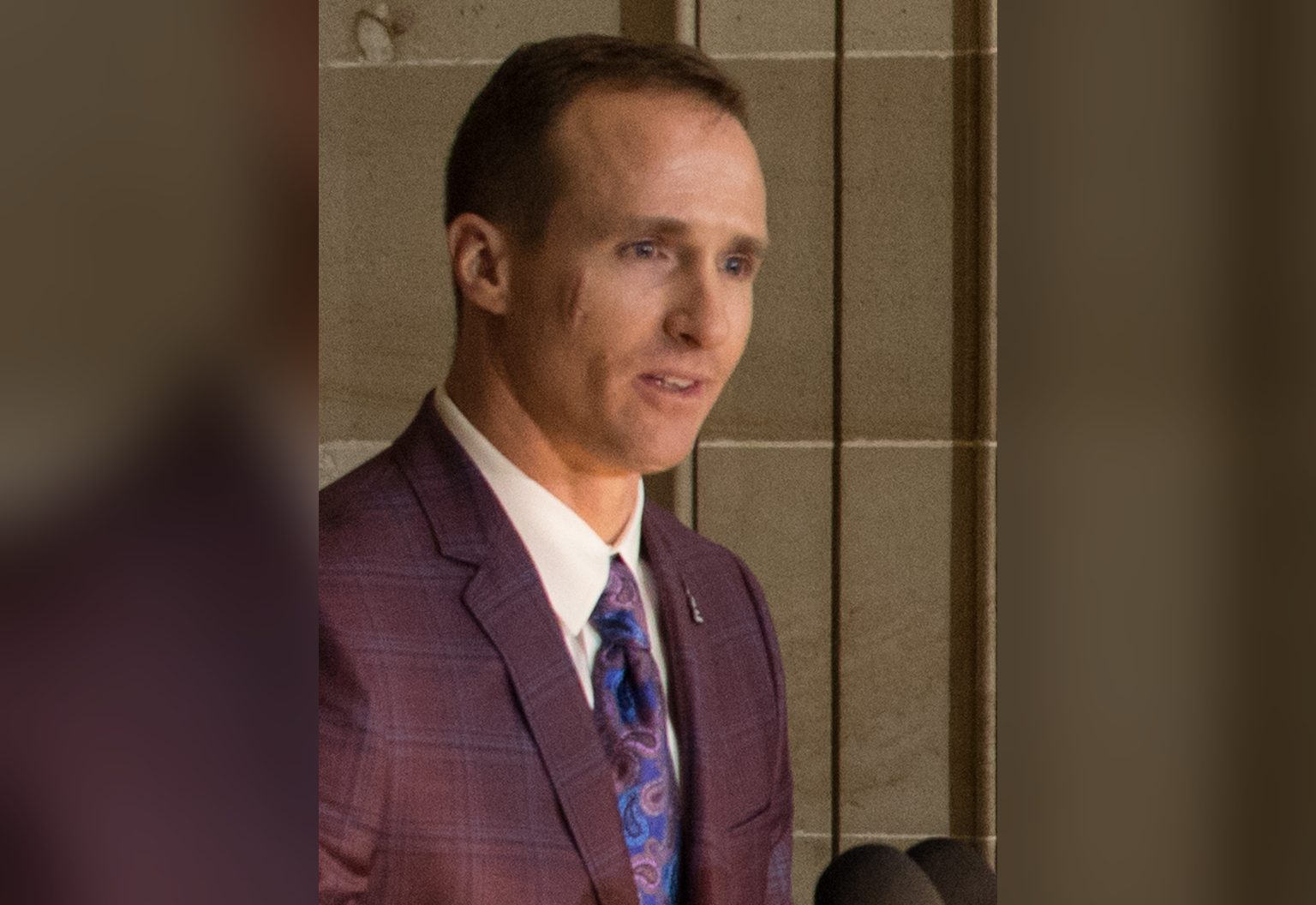
He also stood out for something unrelated to football. Brees has a prominent birthmark on his face, a feature he has discussed publicly over the years, including how his feelings about it changed as he got older.
There was another path available too. Brees was a strong enough athlete that baseball was part of the conversation during his high school years, but football won out.
Purdue gave him the stage
Purdue turned out to be the right fit. Brees arrived in West Lafayette in 1997 and, over four seasons, became the engine of one of the most memorable periods in school history.
He played from 1997 through 2000 and flourished in Joe Tiller’s offense. By the end, Brees had helped transform Purdue from a solid Big Ten program into a national story. In 2000, he led the Boilermakers to a Big Ten title and a Rose Bowl berth, the kind of season that pushed him into the Heisman conversation and onto the national awards circuit.
His biggest individual honors came that year. Brees won the Maxwell Award and was named Big Ten MVP. He was also Big Ten Offensive Player of the Year in 1998 and 2000, and he finished as a Heisman Trophy finalist. The record book filled up along the way: NCAA, conference, and school marks fell in bunches as Purdue leaned into his accuracy and command.
The production mattered, but so did the polish. Brees was already showing the traits that would define his pro career: fast decisions, precise ball placement, and a clear feel for how to run an offense snap to snap.
He completed his degree as well, earning a Bachelor of Science in industrial management from Purdue.
Second-round pick, first real test
The 2001 NFL Draft offered the first reminder that not everyone saw him as a franchise quarterback. The San Diego Chargers selected Brees in the second round with the 32nd overall pick.
That draft slot became part of his story because it framed the questions around him. He was productive, smart, and accomplished, but evaluators worried about size and ceiling. His first NFL years did little to settle the debate immediately.
Brees spent the 2001 through 2005 seasons with the Chargers, appearing in 60 games and starting 58. He threw for 12,348 yards, 80 touchdowns, and 53 interceptions in San Diego. The numbers show a player finding his footing rather than arriving fully formed.
There were bumps. He lost the starting job at one point, then won it back. The breakthrough came in 2004, when he made his first Pro Bowl and won NFL Comeback Player of the Year. For the first time, the league saw the version of Brees that would later become so familiar: efficient, poised, and relentless in preparation.
Then came the shoulder injury that changed everything. In the 2005 season finale, Brees suffered a serious injury to his throwing shoulder. It clouded his future in San Diego and turned free agency into one of the most consequential turning points of his career.
New Orleans and the partnership that changed a franchise
On March 14, 2006, Brees signed with the New Orleans Saints. The contract was for six years and $60 million, but the larger significance was harder to measure at the time. New Orleans was still dealing with the aftermath of Hurricane Katrina, and the Saints were trying to rebuild on and off the field.
Brees gave the franchise immediate credibility.
His first season with the team was a statement. He made the Pro Bowl, earned first-team All-Pro honors, and helped lead the Saints to the NFC Championship Game. The fit with head coach Sean Payton was obvious almost from the start: an aggressive passing game, heavy trust at the line of scrimmage, and a quarterback capable of handling huge volume without losing efficiency.
From 2006 through 2020, Brees played 228 regular-season games for New Orleans and threw for 68,010 yards, 491 touchdowns, and 190 interceptions. Those totals alone explain why his name sits at the center of Saints history, but the year-by-year production tells the fuller story.
He led the NFL in passing yards seven times: 2006, 2008, 2011, 2012, 2014, 2015, and 2016. He led the league in touchdown passes four times: 2008, 2009, 2011, and 2012. He was selected to 13 Pro Bowls overall, with honors in 2004, 2006, 2008 through 2014, and 2016 through 2019. He was named NFL Offensive Player of the Year twice, in 2008 and 2011, and earned second-team All-Pro recognition four times.
For long stretches, the Saints offense ran through his arm at a historic pace. Brees became the first player in NFL history with multiple 5,000-yard passing seasons and finished with five of them, still the most by any quarterback. In 2018, he set the single-season completion percentage record at 74.4 percent, a perfect snapshot of what made him different. He did not overwhelm defenses with size or raw velocity. He beat them with precision.
The Super Bowl season
The defining chapter came in the 2009 season, which ended with the Saints winning Super Bowl XLIV for the first championship in franchise history.
Brees was at the center of it. He threw for 4,388 yards and 34 touchdowns in the regular season, then guided New Orleans through the playoffs and past the Indianapolis Colts in the Super Bowl. In that game, he completed 32 of 39 passes for 288 yards and two touchdowns, earning Super Bowl MVP honors.
That title remains the high point of the Saints’ history, and it fixed Brees permanently in the city’s sports identity. He was not just the quarterback of a winning team. He became the face of a period when the franchise moved from occasional contender to annual factor.
Chasing records late into his career
The back half of Brees’ career became a steady climb through the NFL record book. He tied the league record for touchdown passes in a game with seven. He set the mark for consecutive games with a touchdown pass at 54. He retired as the NFL’s all-time leader in passing yards and completions, and he finished second all-time in touchdown passes at the time of his retirement.
His final career totals: 7,142 completions on 10,551 attempts, a 67.7 completion percentage, 80,358 passing yards, 571 touchdown passes, 243 interceptions, and a 98.7 passer rating. He also added 752 rushing yards and 25 rushing touchdowns.
Those Drew Brees stats tell one story. Watching him told another. He was a rhythmic passer, almost metronomic at times, with a gift for getting the ball out before coverage could settle. He trusted anticipation, not spectacle. That is a big reason his game aged so well.
Brees announced his retirement after the 2020 season, closing a 20-year NFL run that began with questions about measurables and ended with a résumé that placed him among the most accomplished quarterbacks in league history.
Life away from football
Off the field, Brees built a public profile that extended well beyond the stadium.
He married Brittany Dudchenko in February 2003, and the couple have four children: Baylen, Bowen, Callen, and Rylen. The family has long been a visible part of his public life. Reports have also linked Brees to homes in places including San Diego, though residence details can shift and are best treated cautiously unless confirmed directly.
Philanthropy became one of the most consistent parts of his off-field work. In 2003, he and his wife founded the Brees Dream Foundation, which supports cancer patients and provides care and opportunities for children and families in need. The foundation has reported tens of millions of dollars in contributions and commitments over the years.
His ties to New Orleans deepened through that work. Brees was active in recovery and relief efforts connected to Hurricane Katrina, supported organizations such as Boys & Girls Clubs of America, Make-A-Wish, and Dell Children’s Medical Center, and in 2020 announced a $5 million commitment with Ochsner Health to help build healthcare centers in Louisiana.
He also took on civic and business roles. Brees served on the executive committee of the NFL Players Association from 2008 to 2014 and was named co-chair of the President’s Council for Fitness, Sports and Nutrition in 2010. In business, he has been involved with restaurant ownership, fitness and franchise ventures, and several corporate partnerships.
One painful family detail is also part of the public record: Brees’ mother, Mina Brees, died by suicide in 2009. It is a tragic fact in his life story and one that has been reported publicly for years.
Legacy in New Orleans and beyond
Some quarterbacks are remembered for a peak. Others for longevity. Brees had both.
He won one Super Bowl, made 13 Pro Bowls, earned first-team All-Pro honors once and second-team recognition four times, and produced at a level that kept rewriting passing standards. More specifically, he changed what the Saints looked like as a franchise. Before Brees, New Orleans had flashes. With him, it had an era.
That standing has already been recognized formally. He was inducted into the New Orleans Saints Hall of Fame in 2024. He was also selected to the Pro Football Hall of Fame, a fitting final marker for a career built on consistency, volume, and uncommon precision.
FAQ
How many Super Bowls did Drew Brees win?
He won one, Super Bowl XLIV with the New Orleans Saints.
What college did Drew Brees attend?
He played college football at Purdue.
How many Pro Bowls did Drew Brees make?
Brees was selected to 13 Pro Bowls.
How tall was Drew Brees?
He was listed at 6-foot-0.
When did Drew Brees retire?
He retired after the 2020 season and announced it in March 2021.
What position did Drew Brees play?
He played quarterback.
Photo: Senate Democrats, CC BY 2.0, via Wikimedia Commons