Seventeen touchdown catches as a rookie. Twenty-three in a single season a few years later. Before you even get to the full Randy Moss stats page, those two numbers tell you what kind of player he was: a receiver who could tilt a defense, stretch a field and turn a routine snap into a highlight.
Randy Gene Moss was born on February 13, 1977, in Rand, West Virginia. At 6-foot-4 and around 210 pounds during his playing days, he brought unusual range and body control to the position, but his story was never just about measurables. It was about talent that showed up early, detours that nearly changed everything, and an NFL career that still sits near the top of the sport’s receiving records.
A West Virginia athlete before he was an NFL star
Long before he became one of the most recognizable Randy Moss teams-and-stats names in football history, he was a standout at DuPont High School in Belle, West Virginia. Football was only part of the picture. Moss played basketball, baseball and ran track, and that multi-sport background showed up later in the way he moved on a football field.
He was not simply fast in a straight line. He could leap, adjust in the air and track the ball like an outfielder. In high school he played on both sides of the ball, returned kicks and punts, and even handled kicking duties. He also reportedly participated in the school debate team, one of those details that helps round out the picture of a player often reduced to pure athleticism.
His path out of high school was complicated. Moss signed with Notre Dame, but that ended after a battery charge stemming from a fight while he was in high school. He later pleaded guilty to a misdemeanor battery charge, and Notre Dame withdrew his scholarship. That was the first major turn in a career that would include both spectacular production and public scrutiny.
Florida State, then Marshall, where everything took off
Florida State became the next stop, but only briefly. Moss redshirted there in 1995, and his time with the program ended after a parole violation related to marijuana use. At that point, his football future was far less certain than his talent level suggested.
Marshall gave him a new start, and he made the most of it immediately.
In 1996, Moss arrived at Marshall and dominated at the Division I-AA level. He caught 78 passes for 1,709 yards and 28 touchdowns, helping the Thundering Herd win the national championship. He was a first-team All-American and the Jerry Rice Award winner as the top freshman in I-AA.
Marshall then moved up to Division I-A, now known as FBS, and Moss barely slowed down. In 1997 he caught 96 passes for 1,820 yards and 26 touchdowns, won the Biletnikoff Award, earned another first-team All-American selection and finished fourth in the Heisman Trophy voting. That 26-touchdown season set an NCAA Division I-A record at the time.
He also ran track at Marshall and posted elite times there too, another reminder that his speed was not a scouting myth or a highlight-reel illusion. It was measurable.
By the time he left school, Moss had played only two seasons at Marshall, but they were enough to make him one of the most feared receiver prospects in the country.
Draft day value, then instant impact in Minnesota
The Minnesota Vikings selected Moss with the 21st overall pick in the 1998 NFL Draft. Even then, the slide was easy to explain: teams were weighing extraordinary talent against a complicated past.
On the field, the wait looked short almost immediately.
As a rookie, Moss caught 69 passes for 1,313 yards and 17 touchdowns. The touchdown total set an NFL rookie record that still stands. He was named NFL Offensive Rookie of the Year, made the Pro Bowl and earned first-team All-Pro honors. The Vikings went 15-1 in the regular season, and their offense became one of the most explosive units the league had seen.
That first season also established the basic problem he posed to defenses. Press him, and he could run by you. Play off, and he could still get over the top or win at the catch point. Put a safety over him, and somebody else got space.
The first Vikings run and the rise of “Mossing”
From 1998 through 2004, Moss became the centerpiece of Minnesota’s passing game and one of the defining receivers of his era.
He followed his rookie year with 80 catches, 1,413 yards and 11 touchdowns in 1999, then posted 77 catches, 1,437 yards and 15 touchdowns in 2000. In that 2000 season, he and Cris Carter gave the Vikings one of the league’s most dangerous receiving pairings.
His biggest yardage year in Minnesota came in 2003, when he caught 111 passes for 1,632 yards and 17 touchdowns. Across that first Vikings stint, he made defenses look helpless often enough that his name became a verb. “Mossed” entered football language as shorthand for a receiver going up over a defender and taking the ball anyway.
The honors piled up too. During his first run in Minnesota, he made five Pro Bowls and earned three first-team All-Pro selections. In 2000, he signed an eight-year contract extension worth about $75 million.
The relationship with the Vikings eventually ran its course, but by the time he left, the core of his legacy was already in place.
Oakland was quieter, but not the end
In 2005, Minnesota traded Moss to the Oakland Raiders. The move did not produce the same fireworks.
His first season there was still productive by normal standards: 60 catches, 1,005 yards and 8 touchdowns in 13 games. The second year was a clear drop, with 42 catches for 553 yards and 3 touchdowns. Oakland struggled offensively, and Moss never looked fully synced with the situation around him.
Those two seasons matter because they changed the shape of his career. For a moment, it looked as if his peak might have passed earlier than expected.
It had not.
New England and the 23-touchdown season
A fourth-round pick was all it took for the New England Patriots to acquire Moss in 2007, one of the most lopsided value moves of that era.
What followed was one of the great rebound seasons in NFL history.
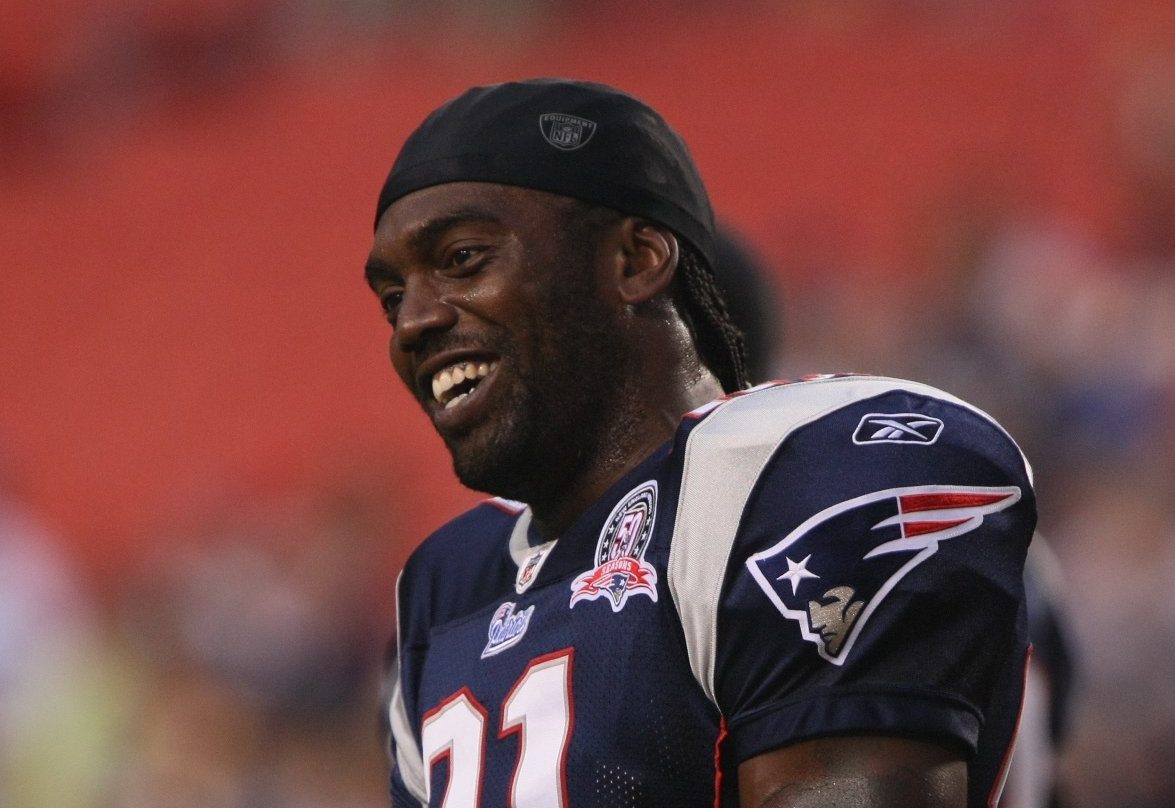
In his first year with Tom Brady, Moss caught 98 passes for 1,493 yards and 23 touchdowns. That touchdown total set the NFL single-season record. New England went 16-0 in the regular season, and the offense was relentless. Moss was not just productive; he was central to how the Patriots stretched defenses and finished drives.
He earned first-team All-Pro honors again and was named the NFL Comeback Player of the Year by the Pro Football Writers of America. The Patriots reached Super Bowl XLII, but their perfect season ended with a loss to the New York Giants.
Moss remained productive in New England after that. In 2008, despite Brady’s season-ending knee injury in Week 1, he still caught 69 passes for 1,008 yards and 11 touchdowns. In 2009, he added 83 catches, 1,264 yards and 13 scores.
His final Patriots season was split by a trade, but his New England run as a whole restored his place among the game’s elite and added one of the defining entries on any Randy Moss career timeline.
A brief return to Minnesota, then Tennessee
In October 2010, the Patriots traded Moss back to the Vikings. The reunion was short and awkward. He played only four games before Minnesota waived him.
That stretch is remembered less for production than for the public tension around it, including postgame comments and questions about fit. Tennessee then claimed him off waivers, and he finished the season with the Titans.
By that point, he was no longer the weekly force he had been in his prime, but the deep threat reputation still followed him everywhere.
One last season, one last Super Bowl trip
Moss sat out the 2011 season, then returned in 2012 with the San Francisco 49ers.
His role was smaller by then. He caught 28 passes for 434 yards and 3 touchdowns during the regular season, working as a veteran piece in a balanced offense. San Francisco reached Super Bowl XLVII, where the 49ers lost to the Baltimore Ravens.
That was the final game of his NFL career.
The numbers, the records and the Hall of Fame case
The full Randy Moss stats line remains one of the strongest ever posted by a wide receiver:
- 982 receptions
- 15,292 receiving yards
- 156 receiving touchdowns
He also scored on a punt return and threw two touchdown passes during his career.
At the time of writing, Moss ranks second in NFL history in receiving touchdowns, behind only Jerry Rice, and remains among the leaders in receiving yards. He posted ten 1,000-yard seasons and led the league in touchdown catches five times.
His major honors include:
- Pro Football Hall of Fame induction in 2018
- NFL 100th Anniversary All-Time Team
- NFL 2000s All-Decade Team
- Six Pro Bowls
- Four first-team All-Pro selections
- NFL Offensive Rookie of the Year in 1998
He was also inducted into the College Football Hall of Fame.
For the Vikings, he remains one of the most important players in franchise history and a central figure in the team’s modern identity.
Why Randy Moss was so hard to defend
Some great receivers win with route detail. Some win with size. Some win with speed. Moss combined all three often enough to make coverage feel pointless.
He could stack a cornerback vertically, track the ball over either shoulder and finish through contact. In the red zone, his catch radius and timing made him a natural scoring threat. In the open field, one false step by a defender could end the play.
What made him especially distinctive was how little margin for error he gave a defense. Even when coverage looked sound, the throw could still be right if it was high and deep enough.
That is a big part of why “Mossing” stuck in the football vocabulary. It described a style of domination people could recognize instantly.
Life after football
Retirement did not take him far from the game. Moss worked for Fox Sports after his playing career and later joined ESPN, where he became a regular NFL analyst. The television role fit him well: direct, experienced and comfortable talking receiver play at a technical level.
Off the field, he has also been involved in business and charitable work, though some reported ventures have changed over time and are not always consistently documented in public records. More firmly established is his long-running interest in the outdoors, especially fishing, which has become a visible part of his post-playing life.
Family has remained part of his public story too. He has several children, including Thaddeus Moss, who played college football at LSU and later reached the NFL. His daughter Sydney Moss built her own standout basketball career in college.
Moss has also spent time coaching at the high school level, including work at Victory Christian Center in Charlotte, North Carolina. That role offered a different view of him: not the vertical threat sprinting past cornerbacks, but the veteran passing along details of the game.
For all the records and highlights, that may be one of the more telling parts of the full profile. Randy Moss was never just a collection of touchdown totals. He was a player whose career moved through brilliance, setbacks, reinvention and lasting influence.
FAQ
What teams did Randy Moss play for?
He played for the Minnesota Vikings, Oakland Raiders, New England Patriots, Tennessee Titans and San Francisco 49ers.
How many touchdowns did Randy Moss have?
He finished his NFL career with 156 receiving touchdowns.
Did Randy Moss win a Super Bowl?
No. He played in Super Bowl XLII with the Patriots and Super Bowl XLVII with the 49ers, and lost both.
When was Randy Moss drafted?
He was selected in the first round of the 1998 NFL Draft, 21st overall, by the Minnesota Vikings.
What is Randy Moss doing now?
He is best known now for his television work as an NFL analyst, particularly with ESPN.
What record does Randy Moss hold?
He still holds the NFL rookie record for receiving touchdowns in a season with 17 in 1998. He also set the single-season NFL mark with 23 touchdown catches in 2007.
Photo: Keith Allison Camera location 38° 54′ 24.48″ N, 76° 51′…, CC BY-SA 2.0, via Wikimedia Commons