Two numbers frame Adrian Peterson’s career better than any slogan could: 2,097 rushing yards in one season, and 296 in a single afternoon. For a stretch of years, that mix of volume and violence made him the runner defenses built entire game plans around.
Peterson, born Adrian Lewis Peterson on March 21, 1985, in Palestine, Texas, arrived in football with unusual momentum and stayed relevant long enough to span eras. He was a high school phenomenon, an Oklahoma star, the seventh pick in the 2007 NFL Draft, an NFL MVP, and eventually one of the most productive backs the league has seen. He finished with 14,918 rushing yards and 120 rushing touchdowns, totals that rank among the best in NFL history.
Early life in East Texas
In Palestine, football was never just an after-school activity. It became structure, release and, at times, refuge.
Peterson grew up in a family shaped by athletic talent and deep hardship. His father, Nelson Peterson, was a standout athlete, and his mother, Bonita Brown, had been a sprinter. But tragedy struck early. When Adrian was a child, his older brother Brian was killed by a drunk driver. Later, his father went to prison. Those events became part of the backdrop to his rise, and people around him often described sports as the place where he poured his energy.
His father gave him the nickname “All Day,” a reference to his endless energy as a boy. Over time, that became “A.D.,” a label that followed him through high school, college and the pros.
At Palestine High School, Peterson turned from gifted local athlete into one of the most watched recruits in the country. He was widely rated the top prospect in the 2004 class, and the attention around him was intense well before he played a college snap.
Oklahoma: immediate impact
Some college stars build slowly. Peterson did not.
At Oklahoma, he made an impact from the start in 2004, rushing for 1,925 yards as a freshman. At the time, that set the NCAA freshman rushing record. He was a unanimous All-American, finished second in Heisman Trophy voting, and quickly looked like the rare back who could change a game even when everyone in the stadium knew he was getting the ball.
He played for the Sooners from 2004 through 2006 and earned first-team All-Big 12 honors in each of his three seasons. The traits that later defined his NFL career were already obvious: long speed once he broke through the line, the balance to survive first contact, and a punishing running style that wore defenses down.
By the time he left Norman, he was viewed as one of the premier running back prospects in the draft.
Minnesota and a rookie season that announced him fast
The Minnesota Vikings selected Peterson with the No. 7 overall pick in the 2007 NFL Draft. Expectations were high. They still undersold how quickly he would explode.
Five games into his rookie season, he produced one of the most famous rushing performances in league history. On October 14, 2007, against the Chicago Bears, Peterson ran for 224 yards in the first half and finished with 296 for the day, setting the NFL single-game rushing record. He also posted 361 all-purpose yards, an NFL rookie record in a game.
That season ended with NFL Offensive Rookie of the Year honors. It also made clear that Minnesota had found the centerpiece of its offense.
Peterson spent 10 seasons with the Vikings, from 2007 through 2016, and that is where most of his legacy was built. With Minnesota, he rushed for 11,747 yards and 97 touchdowns. He made the Pro Bowl seven times as a Viking and repeatedly landed on the All-Pro teams: first team in 2008, 2009, 2012 and 2015; second team in 2007, 2010 and 2013.
The 2012 season and the MVP year
His signature season came after what could have been a career-altering injury.
Late in 2011, Peterson tore his ACL and MCL. Less than a year later, he returned and produced one of the great rushing seasons the NFL has seen. In 2012, he ran for 2,097 yards, just eight short of Eric Dickerson’s single-season record. He was the engine of the Vikings offense that year, carrying the ball 348 times and repeatedly turning ordinary plays into chunk gains.
The awards followed naturally: NFL MVP and NFL Offensive Player of the Year. He remains the most recent non-quarterback to win the league’s MVP award.
That season also cemented his place in Vikings history. Peterson holds the franchise record for rushing yards in a season with those 2,097. He also set the team’s single-season rushing touchdown mark with 18 in 2009 and finished his Minnesota career as the franchise leader in rushing touchdowns.
League-wide, he led the NFL in rushing yards in 2008, 2012 and 2015, and in rushing touchdowns in 2009 and 2015.
The 2014 case and suspension
The biggest interruption in Peterson’s career came away from the field.
In 2014, he was indicted in Texas in a child abuse case stemming from his discipline of his 4-year-old son with a wooden switch. He later pleaded no contest to misdemeanor reckless assault. The NFL suspended him without pay for the remainder of the 2014 season, and he was reinstated in April 2015.
That episode remains the central controversy of his public life and career. It also split his time in Minnesota into two chapters: the dominant rise, and the attempt to resume it after a major off-field case.
When he returned in 2015, he was still highly productive. He led the league with 1,485 rushing yards, tied for the NFL lead with 11 rushing touchdowns, and earned first-team All-Pro honors again.
From New Orleans to Arizona, then a Washington revival
By 2017, Peterson’s long run in Minnesota was over. The next phase of his career became more transient.
He signed with the New Orleans Saints in 2017, but the fit never really clicked. He appeared in four games and rushed for 81 yards before being traded to the Arizona Cardinals. In Arizona, he flashed more of the old form, including a 134-yard debut against Tampa Bay, and finished his Cardinals stint with 448 rushing yards and two touchdowns in six games.
The more substantial late-career stop came in Washington. Signed before the 2018 season, he gave the team a reliable early-down runner and topped 1,000 rushing yards with 1,042 and seven touchdowns. He followed that with 898 yards and five touchdowns in 2019.
Those seasons mattered. They did not recreate his peak, but they showed he could still handle a heavy workload well into his 30s, which is rare for any NFL running back.
Detroit, Tennessee and Seattle
Peterson joined the Detroit Lions in 2020 and played all 16 games, rushing for 604 yards and seven touchdowns. The burst was no longer what it had been in his prime, but the style remained recognizable: downhill, decisive, physical.
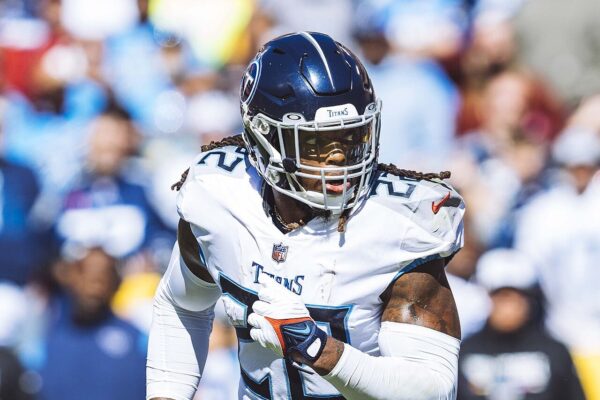
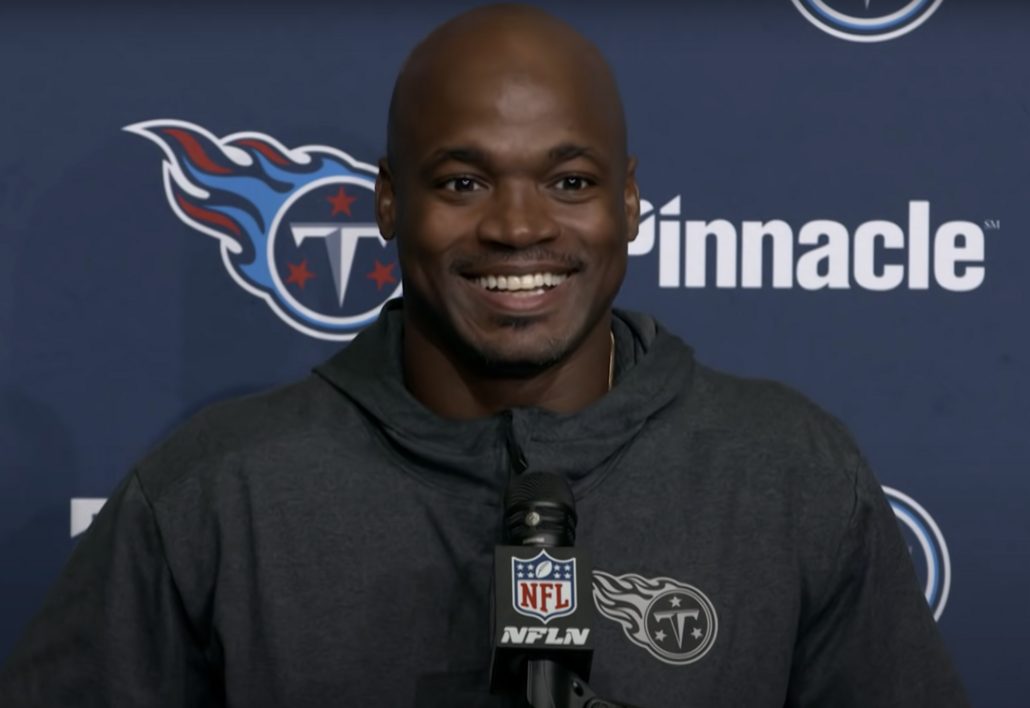
His final NFL season came in 2021, split across two brief stops. He played three games for the Tennessee Titans, rushing for 82 yards and one touchdown, then appeared in one game for the Seattle Seahawks, adding 16 rushing yards and another score.
That Seattle appearance was the last game of his NFL career.
What made Adrian Peterson different
At 6-foot-1 and roughly 220 pounds, Peterson looked like a power back. Then he hit the second level and ran like something else.
His game was built on force, acceleration and balance. He could run through arm tackles, absorb contact without losing speed, and turn a crease into a breakaway run in a few strides. In his best years, he was not simply efficient. He changed the geometry of a defense. Safeties had to creep down. Linebackers had to commit early. One missed fit could become a 50-yard gain.
He was never known primarily as a receiving back, and his career receiving numbers reflect that: 305 catches for 2,474 yards and six receiving touchdowns. But as a pure runner, especially between the tackles, he was one of the defining players of his era.
He was later named to the NFL 2010s All-Decade Team, a fitting summary of how central he was to that period.
Life off the field
Away from football, Peterson’s personal life has often drawn attention, though some details around it have been reported unevenly and should be handled carefully.
He has spoken publicly about family losses, including the death of his son Tyrese in 2013. Reports have also long noted that he has fathered multiple children. Some outlets have identified his wife as Ashley Brown Peterson, but because private-family details are not always consistently documented in public records, it is best to treat parts of that family picture cautiously unless Peterson has confirmed them directly.
He has also been involved in charitable work. His foundation has supported youth and family causes, and in 2020 he donated $100,000 to help COVID-19 relief efforts in Houston. In 2021, he partnered with The Athletes’ Corner and Feeding America to help provide meals in Tennessee and Seattle.
Financial problems surfaced later in his playing career. In 2019, court filings and public reporting showed debt issues, and his attorney said Peterson was under serious financial strain. Claims circulating online about mismanagement tied to charitable operations are not well sourced in mainstream reporting; where they appear, they should be treated as rumor rather than established fact.
His post-playing public record also includes legal trouble. In February 2022, he was arrested at Los Angeles International Airport on a misdemeanor domestic violence allegation. Prosecutors later declined to file charges. In 2024, according to multiple published reports, he was arrested in Texas on suspicion of driving while intoxicated. A claim in the original draft about “a gun charge” was not supported clearly enough here and is better omitted without firm sourcing.
Honors, records and place in history
Peterson’s résumé does not need much polishing. It is already one of the strongest of any modern running back.
He won NFL MVP in 2012, NFL Offensive Player of the Year in 2012, and NFL Offensive Rookie of the Year in 2007. He was selected to seven Pro Bowls and earned seven All-Pro honors across the first and second teams. In college, he set the NCAA freshman rushing record. In the NFL, he set the single-game rushing record with 296 yards.
He finished his career fifth all-time in rushing yards and tied for fifth in rushing touchdowns. For a player whose best work came in an increasingly pass-heavy league, that standing says plenty.
Peterson was inducted into the Texas Sports Hall of Fame in 2023. Under Pro Football Hall of Fame rules, he becomes eligible five years after his final season, which puts his first year of eligibility after the 2021 season cycle.
FAQ
How many Super Bowls did Adrian Peterson win?
None. Peterson never won a Super Bowl.
What is Adrian Peterson’s single-game rushing record?
He holds the NFL record with 296 rushing yards in a game, set against the Bears on October 14, 2007.
How many rushing yards did Adrian Peterson finish with?
He ended his NFL career with 14,918 rushing yards.
Did Adrian Peterson win NFL MVP?
Yes. He won the NFL MVP award for the 2012 season.
What teams did Adrian Peterson play for?
He played for the Vikings, Saints, Cardinals, Washington, Lions, Titans and Seahawks.
When is Adrian Peterson eligible for the Pro Football Hall of Fame?
Because his final NFL season was 2021, his Hall of Fame eligibility begins with the 2027 class.
Photo: Tennessee Titans, CC BY 3.0, via Wikimedia Commons