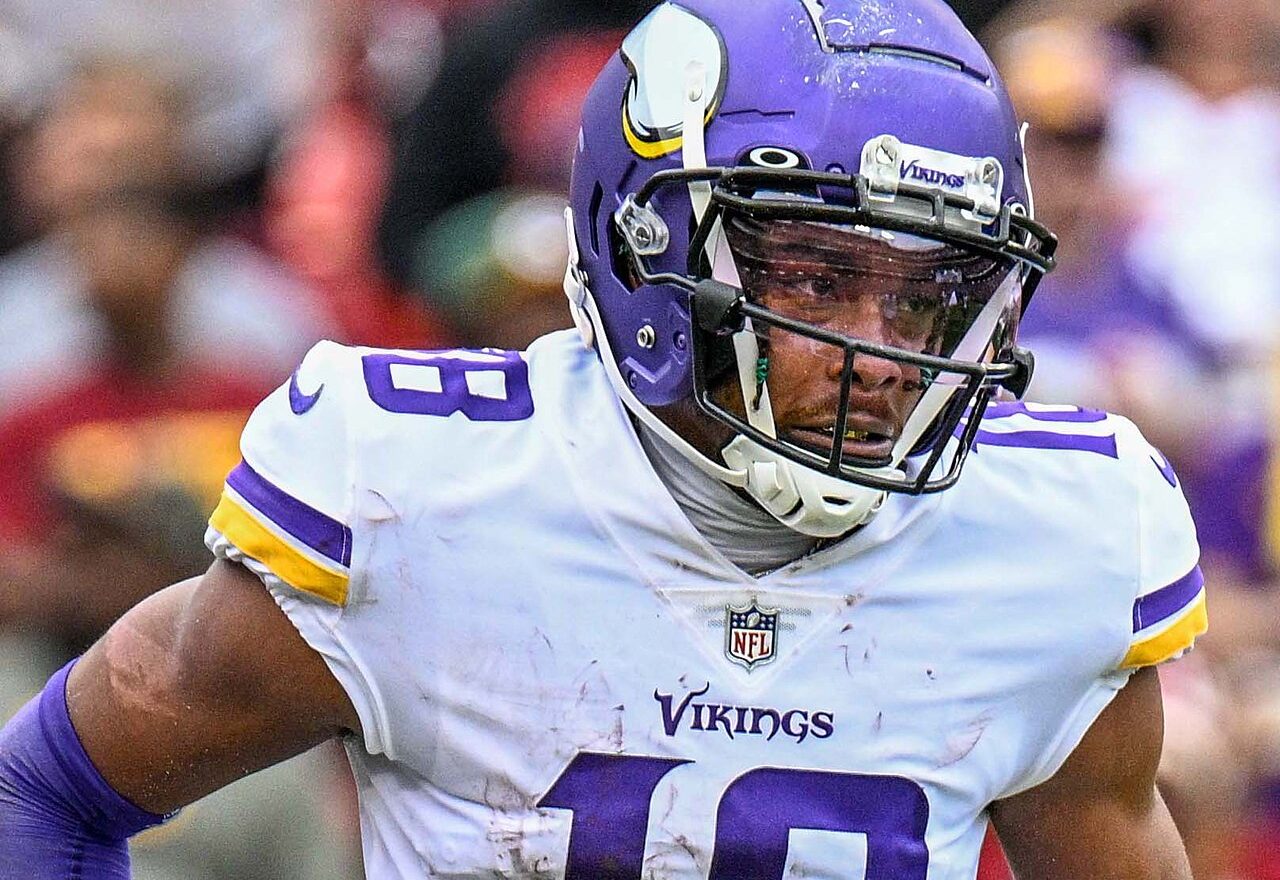
Four touchdown catches in one half of a College Football Playoff game will get scouts’ attention. Justin Jefferson did that for LSU, then carried the same calm, efficient production into the NFL, where his first seasons with the Minnesota Vikings quickly turned into a run at the record book.
There was one stat issue in the original version: through the 2025 season, Jefferson’s career touchdown total should be 42, not 43, based on the season-by-season numbers listed. His career line at that point stands at 579 receptions, 8,480 yards, and 42 receiving touchdowns.
From St. Rose to Destrehan
Justin Jamal Jefferson was born on June 16, 1999, in St. Rose, Louisiana, and grew up in a family where football was part of daily life. His father, John Jefferson, played at Division II College of the Ozarks, and the sport ran through the household. His mother, Elaine, helped hold that competitive family structure together, while Justin and his brothers pushed each other along the way.
The LSU connection started at home before it became public. Older brother Jordan Jefferson played quarterback for the Tigers. Another brother, Rickey Jefferson, played defensive back there. Justin, though, was not treated as the next big national recruit from the start.
At Destrehan High School, he was productive but not heavily hyped, rated as a three-star prospect. That mattered because his path was not built on early celebrity. It was built on steady development. One small childhood detail says plenty: at age nine, he placed third in the national Punt, Pass and Kick competition. Another has followed him ever since-he had a Randy Moss poster on his wall growing up, a fitting choice for a receiver who would later make space look smaller for defenders.
LSU and the season that changed everything
Jefferson arrived at LSU in 2017 and had to handle some business before his college career really started. He needed to pass summer school to be eligible as a freshman. He did, stayed on track, and gradually became a trusted target in Baton Rouge.
By his sophomore season, his role had grown. Then came 2019, the year LSU’s offense became one of the most productive in college football history. With Joe Burrow at quarterback and Jefferson working as a precise, dependable target, the Tigers tore through the schedule and won the national championship.
Jefferson finished that season with 111 catches for 1,540 yards and 18 touchdowns. He was a co-leader nationally in receptions and earned second-team All-SEC honors. The signature moment came in the Peach Bowl against Oklahoma, when he caught four touchdown passes in the first half alone, setting a CFP record for receiving touchdowns in a game.
That postseason performance did not create his draft stock by itself, but it sharpened the picture. He was more than a slot target in a loaded offense. He showed body control, timing, strong hands, and a feel for coverage that translated cleanly to Sundays.
The Vikings draft him at No. 22
Minnesota selected Jefferson with the 22nd overall pick in the 2020 NFL Draft, using a first-round choice on a receiver who had been highly productive but was still discussed in some circles as a player with more polish than flash.
He signed a four-year rookie deal worth $13,122,805, fully guaranteed. It did not take long for the Vikings to realize what they had. Jefferson was not just fitting into the offense. He was changing its shape.
A rookie season that reset expectations
His first NFL year began quietly, then accelerated fast. By the end of the 2020 season, Jefferson had 88 catches for 1,400 yards and seven touchdowns in 16 games.
At the time, those 1,400 yards set the NFL rookie record for receiving yards, surpassing Anquan Boldin’s mark. He made the Pro Bowl, landed on the PFWA All-Rookie Team, earned second-team All-Pro honors, and was named Sporting News Rookie of the Year.
More important than the awards was the way he played. Jefferson did not look overwhelmed by NFL coverage. He looked comfortable finding leverage, adjusting late to the ball, and turning routine completions into chunk gains.
Year two: no slump, just more production
A lot of young receivers flash once. Jefferson followed his debut with an even bigger second season.
In 2021, he posted 108 receptions, 1,616 yards, and 10 touchdowns. He returned to the Pro Bowl, earned second-team All-Pro honors again, and was named NFC Offensive Player of the Month for November.
By the end of that season, he had 196 catches and 3,016 receiving yards through two years, setting the NFL record for receiving yards in a player’s first two seasons and tying the record for receptions over that span.
That early stretch mattered because it changed the conversation around him. He was no longer a promising young wideout. He was already one of the league’s central pass catchers.
2022: league leader and Offensive Player of the Year
Then came the season that pushed him from star to award winner.
Jefferson led the NFL in both receptions and receiving yards in 2022, finishing with 128 catches for 1,809 yards and eight touchdowns. He was selected first-team All-Pro, made another Pro Bowl, and won NFL Offensive Player of the Year.
He also produced one of the biggest single-game receiving totals in Vikings history, setting the franchise record with 223 yards against Detroit.
Minnesota reached the playoffs that season, though the postseason ended quickly. In the Wild Card loss to the New York Giants, Jefferson caught seven passes for 47 yards as the Vikings fell 31-24.
Even with that abrupt finish, the regular season left him at 324 receptions and 4,825 yards through three years-both NFL records for a player’s first three seasons.
2023: fewer games, same standard
A hamstring injury interrupted Jefferson’s 2023 season and limited him to 10 games, but it did not stop his production when he was on the field. He still finished with 68 receptions, 1,074 yards, and five touchdowns.
That kept his 1,000-yard streak alive and pushed him to 5,899 receiving yards through four seasons, the most in NFL history at that point in a career. He also reached 11 games of at least 150 receiving yards in his first four seasons, another notable early-career mark.
The season was a reminder that his game travels well across circumstances. Different quarterbacks, missed time, shifting defensive attention-Jefferson still found a way to produce.
Big contract, big response
Receivers get paid for consistency at the top end of the market, and Minnesota made its commitment clear in 2024. Jefferson signed a four-year, $140 million extension, a deal that made him the highest-paid non-quarterback in the league at the time of signing.
He answered with another elite season: 103 catches, 1,533 yards, and 10 touchdowns. He earned first-team All-Pro honors for the second time and added another Pro Bowl selection.
Minnesota reached the playoffs again, and Jefferson had five catches for 58 yards in a Wild Card loss to the Los Angeles Rams.
By then, the pace of his career had become the story. He reached 6,000 receiving yards in 62 games, matching Lance Alworth as the fastest player to that mark. He also became the fastest player to 30 career 100-yard receiving games and the fastest Vikings receiver to 400 catches, both in 62 games.
Through five seasons, a place in league history
Jefferson’s 2025 season was quieter by his standards but still productive: 84 receptions, 1,048 yards, and two touchdowns. That gave him six straight 1,000-yard seasons to open his career.
More significantly, it left him with 8,480 receiving yards through five seasons, the most in NFL history over that span. His career average through the end of 2025 stood at 98.1 receiving yards per game, an unusually high figure over such a large sample.
That is the thread running through his career. The highlights are obvious, but the real story is repeatability. Season after season, he has produced like a No. 1 target, regardless of volume, coverage, or circumstance.
What makes Justin Jefferson so difficult to defend
Listed at 6-foot-1 and 195 pounds, Jefferson is not built like the biggest receiver in the league, and he does not need to be. His game is based on timing, balance, route detail, and late adjustments to the football.
He can win from the slot or outside. He tracks the ball naturally, rarely looks rushed at the catch point, and has a knack for creating just enough separation without wasting movement. In the red zone, he is effective because he stays under control. Between the 20s, he is dangerous because he turns intermediate throws into explosive gains.
He also wears No. 18, a number with special meaning from LSU. At that program, the jersey is associated with leadership and trust inside the locker room. In Jefferson’s case, it followed him into the pros and became part of his identity with the Vikings.
Off the field: family, the Griddy, and youth camps
The family ties are central to Jefferson’s story, not just a background note. With two brothers who also played at LSU, football was part of the household rhythm long before he became a first-round pick.
Away from the field, he is probably most recognizable to casual fans for helping popularize the Griddy dance. Jefferson did not invent it-that credit is generally given to Louisiana high school football figure Allen Davis-but he became one of its most visible ambassadors in the NFL. In 2021, his version of the celebration crossed into mainstream gaming culture when Fortnite featured the dance.
He has also been involved in youth outreach through his JJets Flight School Camp, giving his public image a community angle beyond highlight clips and endorsement visibility.
As for private life, there is no need to stretch beyond verified public information. Jefferson has kept much of that side of his life relatively private, and any dating rumors or unconfirmed reports should be treated as exactly that-rumor, not fact.
FAQ
How old is Justin Jefferson?
He was born on June 16, 1999.
What college did Justin Jefferson attend?
He played college football at LSU from 2017 through 2019.
When was Justin Jefferson drafted?
The Minnesota Vikings selected him in the first round of the 2020 NFL Draft with the 22nd overall pick.
Has Justin Jefferson won a Super Bowl?
No. He has not won a Super Bowl.
What is Justin Jefferson’s jersey number?
He wears No. 18 for the Vikings.
What are Justin Jefferson’s biggest NFL honors?
His top individual award is NFL Offensive Player of the Year for the 2022 season. He has also earned multiple Pro Bowl and All-Pro selections.
Photo: All-Pro Reels, CC BY-SA 2.0, via Wikimedia Commons