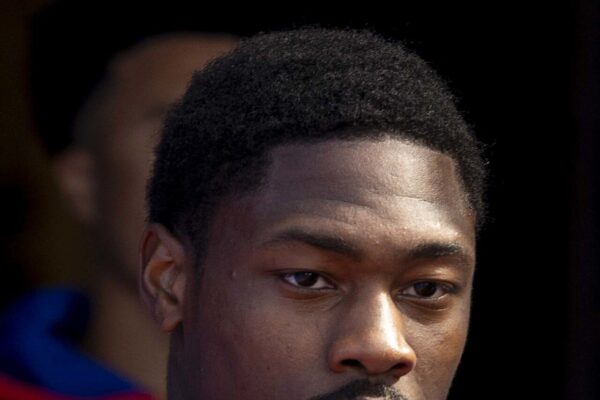

Three Super Bowl rings, 1,549 catches, 22,895 receiving yards, 197 touchdown receptions. Jerry Rice’s résumé still reads like a misprint.
From Mississippi roots to a small-school explosion
Rice was born on October 13, 1962, in Starkville, Mississippi, and grew up in nearby Crawford. He attended B.L. Moor High School in Oktoc, where the outlines of his game started to show early. The family stories have followed him for decades: his father worked as a brick mason, and Rice later said catching bricks helped develop his hands. Another oft-repeated tale had him running after horses as a boy, a detail that fits the endurance and speed that became central to his game, even if it has taken on a near-mythic quality over time.
What is clear, and better documented, is that he was not built on flash alone. Even before college, Rice had a reputation for work, stamina and concentration. Those traits mattered because they never left him. They became the through line of a career that lasted 20 NFL seasons.
Mississippi Valley State and the rise of “World”
At Mississippi Valley State, Rice turned production into publicity. Playing from 1981 through 1984, he went from a talented receiver at a small program to one of the most impossible prospects in college football to ignore.
His numbers were enormous. In 1983, he caught 102 passes for 1,450 yards. In 1984, he topped that with 103 receptions for 1,845 yards and 27 touchdowns. Those seasons helped him set Division I-AA records and forced NFL scouts to pay attention, even if he was doing it outside the sport’s biggest spotlight.
He was a first-team Division I-AA All-American in 1983 and 1984 and the SWAC Player of the Year in 1984. Around campus, he was known as “World,” a nickname that captured how large his catch radius seemed to teammates and coaches.
Mississippi Valley State remained tied to his story long after he left. He was inducted into the College Football Hall of Fame in 2006, and the school’s stadium became Rice-Totten Stadium, honoring both Rice and quarterback Willie Totten, his prolific college teammate.
The 49ers saw what others could not miss
In the 1985 NFL Draft, the San Francisco 49ers selected Rice with the 16th overall pick in the first round. Bill Walsh wanted a receiver who could fit the precision of the 49ers’ passing game, and Rice arrived with unusual polish for a rookie from a small school.
His first season was uneven by his later standards. He caught 49 passes for 927 yards and three touchdowns, then closed the year with a flourish that hinted at what was coming. By his second season, he had become a major part of San Francisco’s offense. By his third, he had become the standard.
The strike-shortened 1987 season remains one of the clearest examples of his peak. In just 12 games, Rice caught 65 passes for 1,078 yards and 22 touchdowns, a touchdown total that still stands as an NFL record for receiving scores in a season. He was named NFL Offensive Player of the Year.
The 49ers years: precision, punishment and titles
San Francisco was where Rice became more than a star receiver. He became the defining pass catcher of his era.
From 1985 through 2000 with the 49ers, he piled up 1,281 receptions, 19,247 receiving yards and 176 touchdown catches. Those numbers alone would make a career. Rice turned them into the backbone of a dynasty.
He won three Super Bowls with San Francisco: XXIII, XXIV and XXIX. The most famous of those performances came in Super Bowl XXIII against the Bengals, when he caught 11 passes for 215 yards and a touchdown and was named Super Bowl MVP. It remains one of the great receiving performances in championship game history.
His honors kept coming because the production never really stopped. Rice made 13 Pro Bowls, earned 10 first-team All-Pro selections, won another Offensive Player of the Year award in 1993, and landed on the NFL’s All-Decade Teams for both the 1980s and 1990s. He was also named to the NFL 75th Anniversary All-Time Team.
The style behind the numbers mattered as much as the totals. Rice was not simply faster or bigger than everyone. He was a master technician. His routes were sharp, his hands were reliable, and his conditioning was famous across the league. The offseason workouts on a steep incline known as “The Hill” became part of NFL lore because teammates and opponents saw the results every Sunday. He could separate late in games because he trained to outlast people.
That combination of detail and discipline is a big reason the phrase Jerry Rice stats still sends readers into a record book. His career was not built on one great season or one brief peak. It was built on repetition at an elite level.
A setback, then another act
Late in his 49ers run, Rice showed another side of his career: resilience. In the opening game of the 1997 season, he suffered a serious knee injury, tearing the ACL and MCL in his left knee. For many players, especially one already deep into his career, that could have marked the beginning of the end.
Instead, he returned that same season, though his comeback was brief after a fractured kneecap in his first game back. He returned fully the next year and kept producing. That response fit the rest of his career. Rice rarely made his story about drama. He made it about work and return.
Oakland gave him one more long run
After the 2000 season, Rice’s long stay in San Francisco ended. He joined the Oakland Raiders in 2001 and immediately showed he was still more than a ceremonial veteran.
Over parts of four seasons with Oakland, he caught 185 passes for 2,509 yards and 18 touchdowns. The Raiders chapter is often treated as an epilogue, but it was more useful than that. Rice remained productive, and in the 2002 season he helped Oakland reach Super Bowl XXXVII.
The Raiders lost that game to Tampa Bay, but the appearance added another deep postseason run to his record. Even in the later years, he was still contributing to playoff teams, still finding space, still catching the ball cleanly.
For anyone searching Jerry Rice teams, the answer is short but significant: 49ers, Raiders, Seahawks, with a brief offseason stop in Denver. The weight of the story, though, sits with San Francisco first and Oakland second.
Seattle, Denver and the end of the career
Rice was traded to the Seattle Seahawks during the 2004 season. In Seattle, he played 11 games and caught 25 passes for 362 yards and three touchdowns. It was a smaller role, and by then the finish line was close.
He signed with the Denver Broncos in 2005 but did not appear in a regular-season game for them. He retired later that year after 20 NFL seasons.
At retirement, his final regular-season totals were almost absurd in their scale: 1,549 receptions, 22,895 receiving yards, 197 touchdown receptions and 208 total touchdowns. He also retired with 14 1,000-yard receiving seasons, 76 career 100-yard games and the most points scored by a non-kicker, 1,256.
The postseason record book tells its own story
Rice’s playoff numbers look like a separate Hall of Fame case.
He finished with 151 postseason receptions, 2,245 receiving yards and 22 touchdown catches, all NFL playoff records. In the Super Bowl alone, he totaled 33 receptions, 589 yards and eight touchdowns, also records.
That matters because it answers one of the usual debates around great regular-season players. Rice did not just compile numbers across a long career. He delivered in January and on the sport’s biggest stage.
Hall of Fame, legacy and the stickum admission
Rice was inducted into the Pro Football Hall of Fame in 2010, his first year of eligibility. By then, the argument for his place in football history had long since been settled.
He is widely regarded as the most productive wide receiver the NFL has seen. Whether someone wants to call him the greatest is a matter of opinion; the statistical case is the easy part. He still owns the career records for receptions, receiving yards and receiving touchdowns, and his longevity is almost as striking as his peak.
One later controversy did enter the conversation. In 2015, Rice acknowledged that he had used stickum during his career, despite the substance having been banned by the NFL long before he played. The admission sparked debate, but it did not change any official records, awards or Hall of Fame standing.
Off the field: family, television and business
Away from football, Rice has remained a visible public figure. He married Jacqueline Bernice Mitchell in 1987; the couple later divorced. Reports have linked him to Latisha Pelayo, and published accounts have said they married, but private-life details beyond that should be treated carefully unless confirmed directly by Rice or reliable public records.
He has four children, including Jerry Rice Jr. and Brenden Rice, both of whom played football. Brenden, in particular, brought the family name back into the college and pro football conversation as a wide receiver in his own right.
Rice also moved comfortably into television and entertainment. In 2006, he competed on Dancing with the Stars and finished second, a reminder that his profile extended well beyond NFL Sundays.
Business has been part of his post-playing life as well. Reports have said he invested heavily in real estate during and after his career, though exact percentages and portfolio details are best treated as reported estimates rather than hard public accounting. What is clear is that Rice did not disappear after retirement. He stayed visible, active and connected to the game.
Why Jerry Rice still stands apart
A lot of records fade because the game changes. Rice’s have held because they were built from every angle: volume, efficiency, durability, postseason production and championship impact.
There have been faster receivers, taller receivers and more physically imposing receivers. Very few have matched his discipline. None have matched the full statistical package. That is why any serious conversation about the best wide receiver in NFL history still runs through Jerry Rice.
FAQ
How many Super Bowls did Jerry Rice win?
He won three Super Bowls with the San Francisco 49ers: XXIII, XXIV and XXIX.
What college did Jerry Rice attend?
He played at Mississippi Valley State from 1981 to 1984.
When was Jerry Rice drafted?
The 49ers selected him in the first round of the 1985 NFL Draft with the 16th overall pick.
What are Jerry Rice’s career stats?
He finished with 1,549 receptions, 22,895 receiving yards and 197 receiving touchdowns in the regular season.
Which teams did Jerry Rice play for?
He played regular-season games for the San Francisco 49ers, Oakland Raiders and Seattle Seahawks. He also had an offseason stint with the Denver Broncos.
Is Jerry Rice in the Hall of Fame?
Yes. He entered the Pro Football Hall of Fame in 2010.
Photo: Anthony Quintano from Honolulu, HI, United States, CC BY 2.0, via Wikimedia Commons