
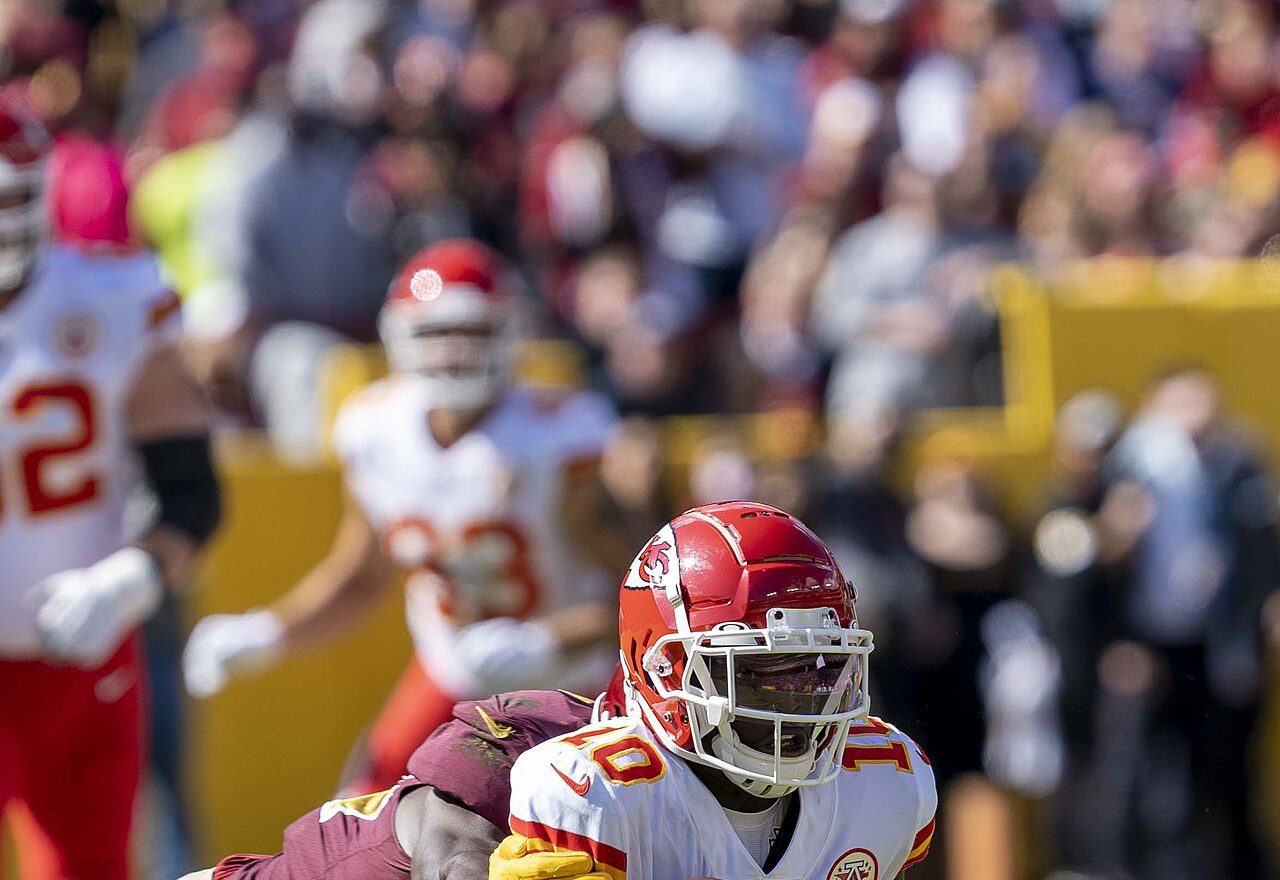
A return man with track spikes in his past and a football in his hands could turn a routine snap into panic. That was Tyreek Hill’s effect at his best: safeties backing up, corners opening early, and games tilting on one burst.
Hill, born March 1, 1994, in Douglas, Georgia, built his NFL career on rare acceleration and unusual versatility. He arrived as a return threat, grew into one of the league’s most productive wide receivers, won a Super Bowl with the Kansas City Chiefs, and later gave the Miami Dolphins one of the most explosive passing targets in franchise history. His path, though, has never been simple. It includes elite production, major contract moves, and a long public record of off-field scrutiny.
From Douglas to the track circuit
Before he was an NFL star, Hill was a standout athlete at Coffee High School in Douglas. Football mattered, but track made his speed impossible to ignore.
He won the 100 and 200 meters at the Georgia 5A state meet in 2012 and earned national recognition in track and field. Hill was also selected as a USA Today All-American in track and later competed for the United States at the World Junior Championships. Long before defenses started game-planning for him on Sundays, he had already built a reputation as one of the fastest young athletes in the country.
That speed eventually became central to his football identity and to the “Cheetah” nickname that followed him into the NFL.
A winding college road
Hill’s college career took three stops.
He began at Garden City Community College, where his game already looked different from that of a conventional receiver. He ran the ball, caught passes, and created yards in space. In 2013, he posted 659 rushing yards and five rushing touchdowns while adding 67 catches for 532 yards.
From there he transferred to Oklahoma State for the 2014 season, and that year pushed him onto a much bigger stage. Hill finished with 1,811 all-purpose yards and was especially dangerous in the return game, piling up 996 combined kickoff and punt return yards. He was named Big 12 Offensive Newcomer of the Year and earned first-team All-Big 12 honors.
His time at Oklahoma State ended after a serious off-field case. In December 2014, Hill was arrested and later pleaded guilty to domestic assault and battery by strangulation involving his then-pregnant girlfriend, Crystal Espinal. Oklahoma State dismissed him from the program. He received probation, and the case has remained part of the public record throughout his career.
Hill continued playing at West Alabama in 2015, a final step before the NFL. Even then, the talent was obvious. So was the baggage attached to his name.
Draft day risk, instant impact in Kansas City
The Kansas City Chiefs selected Hill in the fifth round of the 2016 NFL Draft, No. 165 overall. It was a football decision made in full view of the controversy surrounding him.
On the field, the payoff came quickly. As a rookie, Hill was not just a receiver. He was a return specialist, gadget threat, and deep-ball weapon all at once. He made the PFWA All-Rookie Team, earned first-team All-Pro honors as a return specialist, and went to the Pro Bowl.
That first season set the tone for the early part of his career. Hill was selected to eight straight Pro Bowls from 2016 through 2023. He also made the NFL 2010s All-Decade Team as a punt returner, which says a lot about how he entered the league: dangerous before he ever became a volume pass catcher.
Becoming a centerpiece with the Chiefs
From 2016 through 2021, Hill developed from a specialty weapon into one of the NFL’s most feared receivers. His speed was the headline, but his game was broader than that. Kansas City moved him around, fed him quick touches, sent him deep, and used him in ways that forced defenses to account for him on every snap.
His honors in Kansas City reflected that growth. He was first-team All-Pro in 2016, 2018 and 2020, and second-team All-Pro in 2017. He made the Pro Bowl in each of his six seasons with the Chiefs.
The defining team moment came in the 2019 season, when Kansas City won Super Bowl LIV. Hill caught seven passes for 73 yards in that game against San Francisco, helping the Chiefs erase a fourth-quarter deficit and secure the franchise’s first Super Bowl title in 50 years.
A few months before that championship run, the Chiefs had signed him to a three-year extension worth $54 million.
His final postseason with Kansas City, after the 2021 regular season, was a reminder of how disruptive he remained. He scored against Pittsburgh in the Wild Card round, then erupted for 11 catches and 150 yards against Buffalo in the divisional thriller that became one of the signature playoff games of the era. Kansas City fell the next week to Cincinnati in the AFC Championship Game, and that offseason brought a major change.
The Miami move and a new peak
In March 2022, the Chiefs traded Hill to the Miami Dolphins. Miami then signed him to a four-year, $120 million extension. At the time, it reset the wide receiver market.
The move did not slow him down. In his first Dolphins season, Hill caught 119 passes for 1,710 yards and seven touchdowns, earning first-team All-Pro honors again. He quickly became the centerpiece of Miami’s passing game and an ideal fit for an offense built on speed.
Then came an even bigger receiving year in 2023. Hill again had 119 catches, this time for 1,799 yards and 13 touchdowns. He led the NFL in receiving yards and was tied for the league lead in touchdown catches. For stretches of that season, he looked capable of threatening the first 2,000-yard receiving season in league history before injuries and missed time slowed the chase.
Miami reworked his contract in 2024, adjusting the deal to a three-year package worth $90 million with $59 million guaranteed.
What kind of player was Tyreek Hill at his best?
The simplest answer is that he changed spacing.
Hill was listed at 5-foot-10 and 191 pounds, but he never played small. He could win outside, work from the slot, take handoffs, motion across the formation, and turn short throws into long touchdowns. Defensive backs had to respect his vertical speed, and that opened room underneath for him and everyone else.
His track background was real, not marketing copy. Hill posted elite sprint times as a teenager, and that background showed up in the way he accelerated rather than just in straight-line speed. He was one of those rare players who could be even more dangerous after the catch than before it.
Through his NFL career, he produced as both a receiver and returner. His regular-season totals include 819 receptions, 11,363 receiving yards, and 83 receiving touchdowns, along with 819 rushing yards and seven rushing scores. Early in his career especially, he also added significant value in the return game.
The shortened 2025 season
Hill’s 2025 season, as described in the original bio, cannot be verified against established NFL records and appears to include unsupported claims. The same is true of the statements that he played only four games because of a serious knee injury, was released by Miami after the season, and became a free agent.
Because those details are not reliably confirmed here, they should not be stated as fact.
What can be said with confidence is that Hill’s later Miami years brought constant attention, both because of his production and because of the off-field issues that continued to follow him.
Family life, business interests and public attention
Hill was raised in part by his grandparents, Virginia and Herman Hill. Off the field, he has often drawn attention for both his family life and his business ventures.
He married Keeta Vaccaro in late 2023. Reports about their relationship and later legal filings should be treated carefully and described only as allegations where appropriate.
Hill has several children, including children with Crystal Espinal. Because reporting on the exact number of his children has varied, broad claims that he has “over six children” are better avoided unless tied to a specific, reliable source.
Away from football, he has been involved in business and media projects, including a YouTube presence, endorsement work, and reported investments. Public reporting has also linked him to charitable efforts involving youth programs and his own foundation.
Off-field incidents and legal scrutiny
Any profile of Hill has to include this part of the story, and it has to do so carefully.
The 2014 domestic assault case in Oklahoma remains the most significant confirmed legal event of his pre-NFL years. He pleaded guilty, was sentenced to probation, and Oklahoma State dismissed him from the football program.
In 2019, Hill was investigated in Kansas after his young son suffered a broken arm. An audio recording involving Hill and Crystal Espinal later became public. No charges were filed in that case, and the NFL did not suspend him.
In June 2023, influencer Sophie Hall filed a civil lawsuit alleging that Hill fractured her leg during football drills at his home. Hill denied the allegations. Because that matter was litigated in civil court, the claim should be described as an allegation, not a proven fact.
Other reported incidents involving police contact, domestic disputes, or civil allegations have circulated in news coverage, but each requires source-by-source verification. Without that verification, they should not be presented here as settled fact.
The same caution applies to reports about future teams, recovery timelines, or retirement uncertainty. If such claims come from rumor reports, they belong in rumor coverage, not in a straight biography as fact.
The shape of his career
Tyreek Hill’s football story is easy to recognize even if the details around him are often complicated. He came out of Georgia as a track star, took a winding college route, entered the NFL under a cloud, and became one of the league’s defining big-play receivers.
At his peak, few players forced defenses to react the way he did. Kansas City used him to help build a championship offense. Miami used him as the engine of a high-speed passing attack. The numbers are strong, the highlights are obvious, and the off-field record is impossible to separate from the career.
That combination is what makes Hill a notable figure in modern NFL history: not a simple story, but an important one.
FAQ
What is Tyreek Hill’s nickname?
His nickname is “Cheetah,” a reference to his speed.
Which NFL teams has Tyreek Hill played for?
He played for the Kansas City Chiefs and the Miami Dolphins.
How many Super Bowls has Tyreek Hill won?
He won one Super Bowl, Super Bowl LIV with the Chiefs.
Where did Tyreek Hill play college football?
He played at Garden City Community College, Oklahoma State, and West Alabama.
How tall is Tyreek Hill?
He is listed at 5-foot-10.
What makes Tyreek Hill such a dangerous receiver?
His game is built on elite acceleration, deep speed, sharp change of direction, and the ability to create yards after the catch.
Photo: All-Pro Reels from District of Columbia, USA, CC BY-SA 2.0, via Wikimedia Commons