Twelve thousand one hundred twenty-four rushing yards. Derrick Henry put up that number before he ever reached college, turning Friday nights at Yulee High School into a national story and leaving with the national high school career rushing record.
That scale has followed him almost everywhere since.
At 6-foot-3 and around 250 pounds, Henry never looked like a typical feature back. He was bigger, more upright, and somehow still fast enough to erase angles once he reached the second level. What made him different, though, was not just the build. It was the way his career kept stacking the same themes at every stop: huge workloads, unusual durability, and production that held up against better and better competition.
Yulee roots and a record-setting high school run
Derrick Lamar Henry Jr. was born in Yulee, Florida, and was raised primarily by his grandmother, Gladys. Family has long been central to his story. He has said she helped shape his discipline, and she gave him one of his early nicknames, “Shocka,” a family reference to the surprise around his birth while his parents were still teenagers.
At Yulee High, Henry became far more than a local standout. He played football, but also spent time in track and basketball, which helps explain why a player later known for punishing runs also had real long speed. On the field, his production quickly moved beyond normal high school star numbers.
By the end of his prep career, he had rushed for 12,124 yards, a national record. He was a five-star recruit and one of the most coveted players in the country. The numbers alone made him famous, but they also introduced the style that would define him later: a back who could handle a heavy load, keep his power deep into games, and break long runs after defenders had already spent four quarters trying to tackle him.
Alabama, patience, and the Heisman season
Henry arrived at Alabama in 2013, entering a backfield where touches were never handed out easily. His college career did not begin as a straight climb to stardom. He had to wait, share carries, and, according to published accounts from that period, at one point considered transferring before eventually staying in Tuscaloosa.
That decision changed everything.
By 2015, he had become the engine of Alabama’s offense. He rushed for 2,219 yards and 28 touchdowns, won the Heisman Trophy, and swept up many of the sport’s other major honors, including the Maxwell Award, Walter Camp Award and Doak Walker Award. He was also a unanimous All-American.
The season was not just about awards. Alabama won the national championship, and Henry broke Herschel Walker’s long-standing SEC single-season rushing record. In a conference built on elite defensive fronts, he kept coming. That was the year his game became unmistakable: not flashy in the usual sense, but relentless, punishing, and increasingly hard to stop once the game wore on.
He remains the only player to record a 2,000-yard rushing season in high school, college and the NFL, a rare thread connecting every stage of his football life.
Draft day and the start of his Titans career
The Tennessee Titans selected Henry in the second round of the 2016 NFL Draft, taking him with the 45th overall pick. He entered the league with a strong combine behind him, including a 4.54-second 40-yard dash, an eye-catching time for a runner of his size.
His early seasons in Tennessee required another adjustment. DeMarco Murray was still in the backfield, and Henry was not immediately used as a full-time centerpiece. For a while, his NFL career looked like it might follow the same pattern as his college one: wait, learn, then take over when the opening came.
That opening arrived.
Tennessee’s closer becomes its identity
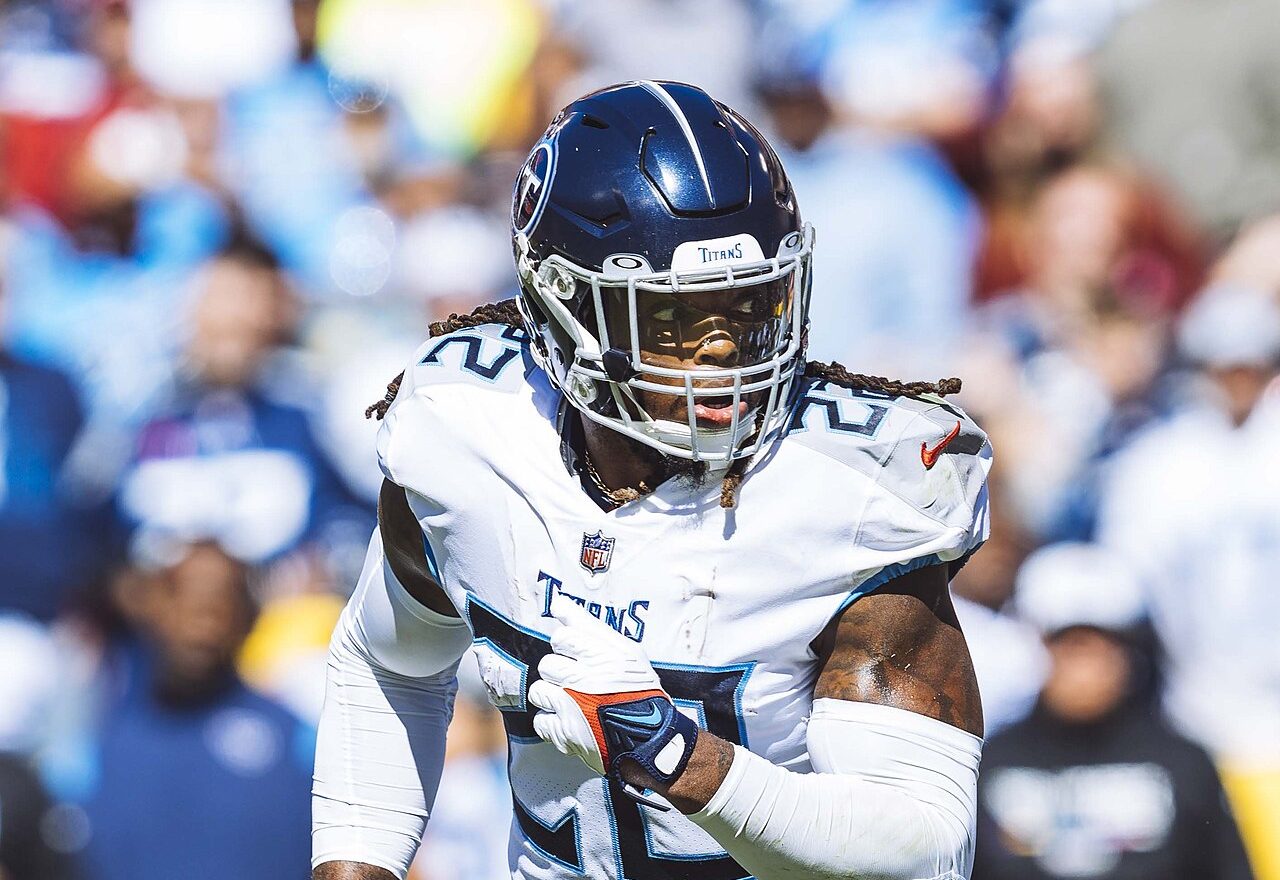
From 2018 on, Henry became one of the defining runners of his era. Tennessee leaned into what he did best: downhill runs, heavy volume, and a game plan that often looked even better in the fourth quarter than it did in the first.
His breakout stretch late in 2018 included the famous 99-yard touchdown run against Jacksonville, tied for the longest run in NFL history. It was the perfect Henry play. He shrugged off contact near the line, got into the open field, and suddenly a man built like a defensive end was outrunning everyone.
The next two seasons turned him into the face of the Titans offense. In 2019, he led the NFL in rushing yards with 1,540 and in rushing touchdowns with 16, earning his first Pro Bowl nod and second-team All-Pro honors. Tennessee rode that formula all the way to the AFC Championship Game.
Then came 2020, the biggest NFL season of his career. Henry rushed for 2,027 yards and 17 touchdowns, becoming the eighth player in league history to top 2,000 rushing yards in a season. He led the NFL again in rushing yards and rushing touchdowns, was named first-team All-Pro, and won AP NFL Offensive Player of the Year.
Tennessee rewarded him before that season with a four-year, $50 million extension.
Even when injuries interrupted the rhythm later on, the production stayed strong. A foot injury cut short his 2021 regular season after eight games, but he still returned for the playoffs. He was back over 1,500 rushing yards in 2022 and remained a Pro Bowl player in 2023, his final season with the Titans.
Across eight seasons in Tennessee, Henry rushed for 9,502 yards and 90 touchdowns in the regular season. He left as one of the most productive players in franchise history and the player most closely associated with the Titans’ identity during that stretch.
A new chapter in Baltimore
In March 2024, Henry signed with the Baltimore Ravens, joining an offense that already stressed defenses with Lamar Jackson’s mobility. On paper, it looked like a natural fit: a power back with home-run speed paired with one of the league’s most dangerous quarterbacks.
The move also gave Henry something every veteran star eventually faces, a chance to show his game could travel.
It did. In his first season with Baltimore, he remained one of the league’s most productive runners, earning another Pro Bowl selection, second-team All-Pro honors, and leading the NFL in rushing touchdowns. He gave the Ravens exactly what they wanted: a back who could finish drives, control tempo, and punish defenses that had already spent the day accounting for Jackson.
Any references to exact current-season totals can change quickly, so the larger point matters more here: Derrick Henry has extended his career beyond Tennessee without losing the style that made him such a problem in the first place.
Why Derrick Henry has been so hard to defend
There have been plenty of productive backs in modern football. Few have looked like this.
Henry’s game has always started with size, but it has never been only about size. He runs with long strides that can make him seem almost upright, then suddenly he is through an arm tackle and building speed. Defensive backs often face the worst version of him late in games, when they have already spent three quarters dealing with his power.
He has also been unusually durable for a player with such a heavy workload. That matters when talking about his place among the best runners of his generation. Henry was not built on one brilliant season. He has piled up years of high-volume production, including multiple rushing titles and one of the great 2,000-yard campaigns in league history.
The nicknames tell part of the story. “King Henry” is the one most fans know. “El Tractorcito,” popularized in Spanish-language broadcasts, fits too. He has often looked less like a conventional running back than a machine gathering force.
Life away from football
Off the field, Henry has generally kept a lower profile than many stars of his stature, but a few details are well established.
He has been in a long-term relationship with Adrianna Rivas, and the couple have children together. He has also spoken about wearing No. 22 in honor of a late friend, a personal detail that says something about the meaning attached to a number most fans simply recognize on sight.
In business, Henry has built a broad endorsement portfolio, with reported partnerships including Nike, Old Spice, Campbell’s Chunky, Pepsi, Pizza Hut and GEICO. He has also been reported as a minority investor in Nashville SC.
Community work has been a consistent part of his public profile as well. He was named the Ravens’ nominee for the Walter Payton NFL Man of the Year Award, recognition tied to his charitable efforts and youth-focused outreach.
As for net worth figures and total earnings estimates, those numbers often vary by outlet and are rarely confirmed by the player himself, so they are best treated as estimates rather than settled fact.
FAQ
What college did Derrick Henry attend?
He played college football at Alabama.
When did Derrick Henry win the Heisman Trophy?
He won the Heisman in the 2015 season.
Which NFL teams has Derrick Henry played for?
He has played for the Tennessee Titans and the Baltimore Ravens.
Did Derrick Henry rush for 2,000 yards in the NFL?
Yes. He rushed for 2,027 yards in the 2020 season.
What is Derrick Henry’s nickname?
The most common nickname is “King Henry.” He has also been called “Shocka” and “El Tractorcito.”
What number does Derrick Henry wear?
He wears No. 22.
Photo: All-Pro Reels, CC BY-SA 2.0, via Wikimedia Commons