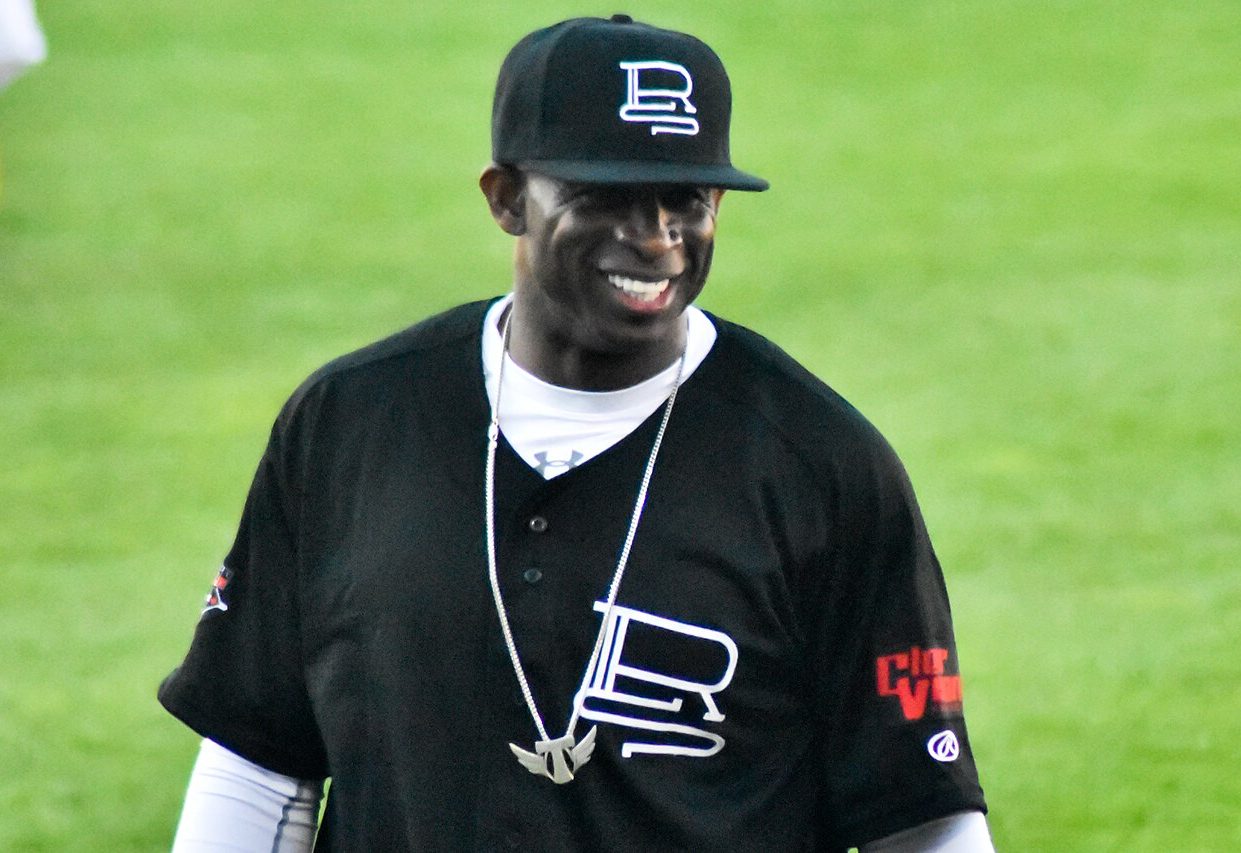
On one October day in 1992, Deion Sanders played an NFL game and an MLB postseason game within hours of each other. That detail says almost everything about the scale of his career. Before he became known to a new generation as Coach Prime, Sanders was the rare football star who could change a game on defense, on special teams, and occasionally on offense, all while maintaining a second life in professional baseball.
From Fort Myers to “Prime Time”
Deion Luwynn Sanders Sr. was born on August 9, 1967, in Fort Myers, Florida, and his rise started early. At North Fort Myers High School, he was not simply a standout football player. He earned All-State honors in football, basketball, and baseball, the kind of three-sport résumé that made recruiters and scouts pay attention long before the NFL entered the picture.
The nickname “Prime Time” traces back to those school years. It fit because Sanders never played like he wanted to blend in. He was fast, loose, and unmistakably confident, with a style that drew attention but also matched the production. Years later, he was named to the Florida High School Association All-Century Team, a nod to how fully he had stamped those early seasons.
Florida State and a national profile
At Florida State, Sanders became one of the most dynamic athletes in the country. From 1985 through 1988, he played football, ran track, and also spent time in baseball, extending the multi-sport pattern that had defined him in high school.
Football was where his national reputation took shape. As a cornerback, he developed into one of the best defensive backs in school history. He was a two-time consensus All-American in 1987 and 1988, won the Jim Thorpe Award in 1988, and finished his college career with 14 interceptions. Four of those were returned for touchdowns, a Florida State record at the time.
He was just as dangerous once the ball found him in space. In 1988, Sanders led the nation in punt return average at 15.2 yards per return, a number that previewed the NFL version of his game. He was not just a cover corner. He was a field-position swing waiting to happen.
Baseball organizations noticed too. The Kansas City Royals drafted him in 1985, and the New York Yankees selected him in 1988. Even before the draft, it was clear that Deion Sanders was not going to have a conventional career.
The 1989 NFL Draft and the Atlanta years
The Atlanta Falcons took Sanders with the fifth overall pick in the 1989 NFL Draft. He entered the league as a cornerback first, but that title never fully covered what he did. He returned punts and kickoffs, saw occasional snaps on offense, and brought a level of speed that changed game plans.
His first NFL stop, from 1989 through 1993, was where the full package came into focus. Sanders quickly became one of the league’s premier man-to-man corners, the kind of defender quarterbacks preferred not to test. But when they did, he had a habit of turning mistakes into points.
That became one of the defining themes of his career. He did not pile up interceptions at the volume of some ballhawks, finishing with 53 in the regular season, but the damage after the catch was different. Sanders turned takeaways into long returns and touchdowns, and he did the same on special teams. He was a defensive back with a return specialist’s instincts and a sprinter’s acceleration.
San Francisco, 1994, and the peak season
Sanders spent the 1994 season with the San Francisco 49ers, and it remains the clearest single-year snapshot of how dominant he could be. He intercepted six passes, returned three for touchdowns, and won NFL Defensive Player of the Year.
That season ended with a Super Bowl XXIX title, the first championship of his NFL career. The numbers mattered, but so did the role. By then, he had become the cover corner offenses built around avoiding. His presence allowed coaches to be aggressive elsewhere because one side of the field could effectively disappear.
If one season explains why Deion Sanders belongs in any conversation about the best cornerbacks of his era, it is 1994.
Dallas, another title, and the biggest stage
In 1995, Sanders signed with the Dallas Cowboys, joining a roster already built to contend. The fit was immediate. Dallas won Super Bowl XXX, giving him championships in back-to-back seasons with different teams.
His Cowboys run lasted from 1995 through 1999 and helped cement the full shape of his legacy. Across the decade, Sanders earned eight Pro Bowl selections and six first-team All-Pro honors. He was first-team All-Pro in 1992, 1993, 1994, 1996, 1997, and 1998, with second-team All-Pro recognition in 1991 and 1999.
Those honors reflect both longevity and impact. Sanders was not just a recognizable personality; he was one of the NFL’s most effective defenders for a long stretch. He could erase top receivers in man coverage, bait quarterbacks into risky throws, and turn a routine return into a touchdown.
His financial profile also stood out in that period. Reports at the time tied his 1995 earnings to both the Cowboys and the Cincinnati Reds, part of the unusual overlap between his football and baseball careers. Exact modern inflation estimates vary, so it is safer to say Sanders was among the highest-profile multi-sport earners of his era.
Washington, Baltimore, and the final seasons
After Dallas, Sanders played one season in Washington in 2000. He retired, then returned to the NFL with the Baltimore Ravens for the 2004 and 2005 seasons. His final NFL season was 2005.
By the end of his playing career, he had appeared in 188 regular-season games. He also caught 60 passes for 784 yards and three touchdowns, a reminder that even in the NFL, his job description was never limited to one line on a roster sheet.
What made Deion Sanders different
Some great defensive backs are remembered for accumulation. Sanders is remembered for impact. His career totals include 53 interceptions, 1,331 interception return yards, and nine interception return touchdowns. He also scored six punt-return touchdowns, three kickoff-return touchdowns, and one fumble-return touchdown in the regular season.
Those numbers help explain the larger point: once Sanders got the ball, the play was not over. It was just becoming dangerous.
He remains tied for second in NFL history in interception-return touchdowns, and his 25.1 yards per interception return ranks among the best ever for players with substantial interception totals. For years, he was also credited with the NFL record for combined return touchdowns across interceptions, punts, kickoffs, and fumbles; depending on the category and era, return-stat leaderboards can be split in different ways, but the broader truth holds. Few players in league history have been a scoring threat in as many phases of the game.
The style matched the production. Sanders played with elite recovery speed, loose hips, and unusual confidence in press and off-man coverage. He was a true shutdown corner, but he was also a showman, and in his case the show rarely came without substance.
The baseball career that ran beside football
Sanders did not merely dabble in baseball. He played nine MLB seasons with the New York Yankees, Atlanta Braves, Cincinnati Reds, and San Francisco Giants. He is the only athlete to appear in both a Super Bowl and a World Series, one of those facts that sounds exaggerated until you check it.
The most famous crossover moment came on October 11, 1992, when he played for the Falcons and then traveled to join the Braves during the National League Championship Series. That day became part of sports folklore because it captured what made his career so unusual: he was not choosing between two elite levels. For a time, he was living in both.
Life away from the field
Sanders’ family has long been part of his public story. He was married to Carolyn Chambers from 1989 to 1998 and later to Pilar Sanders from 1999 until their divorce was finalized in 2013. He has five children: Deiondra, Deion Jr., Shilo, Shedeur, and Shelomi.
His sons Shilo and Shedeur have both played under him, which has added another layer to his football life. That family connection became especially visible during his coaching years.
Not every off-field venture went smoothly. Sanders helped found Prime Prep Academy in 2012 and worked there in a coaching role, but the charter school closed in 2015 amid well-documented financial and academic problems. That chapter remains part of his public record.
He has also been active in camps, media, and endorsements. Over the years, Sanders has been linked with brands including Nike, Pepsi, Sega, Burger King, and American Express, among many others. More recent partnerships have added to the business side of the “Prime” brand, though descriptions of a wider family “empire” are better treated as marketing language than hard fact.
His health has also become part of his story. Sanders has spoken publicly about serious circulation issues, multiple surgeries, blood clots, and the amputation of two toes on his left foot. It was a stark turn for a player once defined by speed, and it added visible weight to his later coaching years.
Hall of Fame and the move into coaching
In 2011, Sanders was inducted into both the Pro Football Hall of Fame and the College Football Hall of Fame. Few careers fit that double honor more neatly. He had been a college star, an NFL champion, a Defensive Player of the Year, and one of the most distinctive athletes of his generation.
Retirement did not end his visibility in the sport. Sanders moved into broadcasting and then coaching, first at the high school level, later at Jackson State, and then at Colorado. That second act gave him a new audience and a new title, but it also echoed the old one. The confidence, the camera presence, and the ability to command attention were all familiar. So was the football substance behind it.
For all the nicknames, the crossover fame, and the flash, the core of the story is simple enough. Deion Sanders changed games in ways very few players ever have, and he did it across more than one sport.
FAQ
What teams did Deion Sanders play for in the NFL?
He played for the Atlanta Falcons, San Francisco 49ers, Dallas Cowboys, Washington, and Baltimore Ravens.
What position did Deion Sanders play?
He was primarily a cornerback, but he also played as a punt returner, kick returner, and occasional wide receiver.
Did Deion Sanders win a Super Bowl?
Yes. He won Super Bowl XXIX with the 49ers and Super Bowl XXX with the Cowboys.
Did Deion Sanders play baseball?
Yes. He played nine seasons in Major League Baseball for the Yankees, Braves, Reds, and Giants.
Is Deion Sanders in the Hall of Fame?
Yes. He was inducted into the Pro Football Hall of Fame and the College Football Hall of Fame in 2011.
Is Deion Sanders a coach?
Yes. After his playing career, he moved into coaching and became head football coach at the University of Colorado.
Photo: Erik Drost, CC BY 2.0, via Wikimedia Commons