A broken leg in high school helped shape the path. Justin Herbert was not the quarterback recruit with a coast-to-coast spotlight and a stack of blue-blood offers. He was a tall, talented passer from Eugene who stayed home, chose Oregon, and built his rise the slower way.
From Eugene to Oregon’s starting job
Justin Patrick Herbert was born on March 10, 1998, in Eugene, Oregon. Sports were part of the family rhythm. His parents, Mark and Holly Herbert, raised three sons, and football stayed close to home; his brother Patrick later played tight end for Oregon.
At Sheldon High School, Herbert played football, basketball and baseball, the kind of three-sport background that often shows up in quarterbacks who move easily and throw naturally. His recruiting story, though, was less glamorous than his NFL profile would later suggest. A broken leg during high school complicated his exposure, and his FBS options were limited. Oregon and Nevada offered. He chose the Ducks and never left his home state.
That decision ended up defining the first chapter of his career.
Oregon years: production, patience and a Rose Bowl finish
Herbert arrived at Oregon in 2016 and quickly moved from prospect to starter. He became the first true freshman to start at quarterback for the Ducks since 1983, an early sign of how much trust he earned inside the program.
His college career had a little of everything: big numbers, injuries, steady development and a strong finish. Across four seasons, he threw for 10,541 yards and 95 touchdowns, finishing second in school history in both categories at the time. He also set Oregon records for completions (827) and pass attempts (1,293).
The most complete version of Herbert showed up in his final season. Oregon won the Pac-12 championship, then beat Wisconsin in the Rose Bowl to close the year. Herbert was named Offensive MVP of that game after accounting for four total touchdowns, a fitting last college performance for a quarterback who had spent years carrying high expectations.
There was another side to his Oregon résumé that followed him into the NFL. Herbert was one of the sport’s standout student-athletes, winning the 2019 William V. Campbell Trophy, often called the Academic Heisman. He studied biology and was named a first-team Academic All-American. Different sources have listed his GPA slightly differently, but the larger point is clear: he was known on campus for more than his arm.
The 2020 draft and an unexpected debut
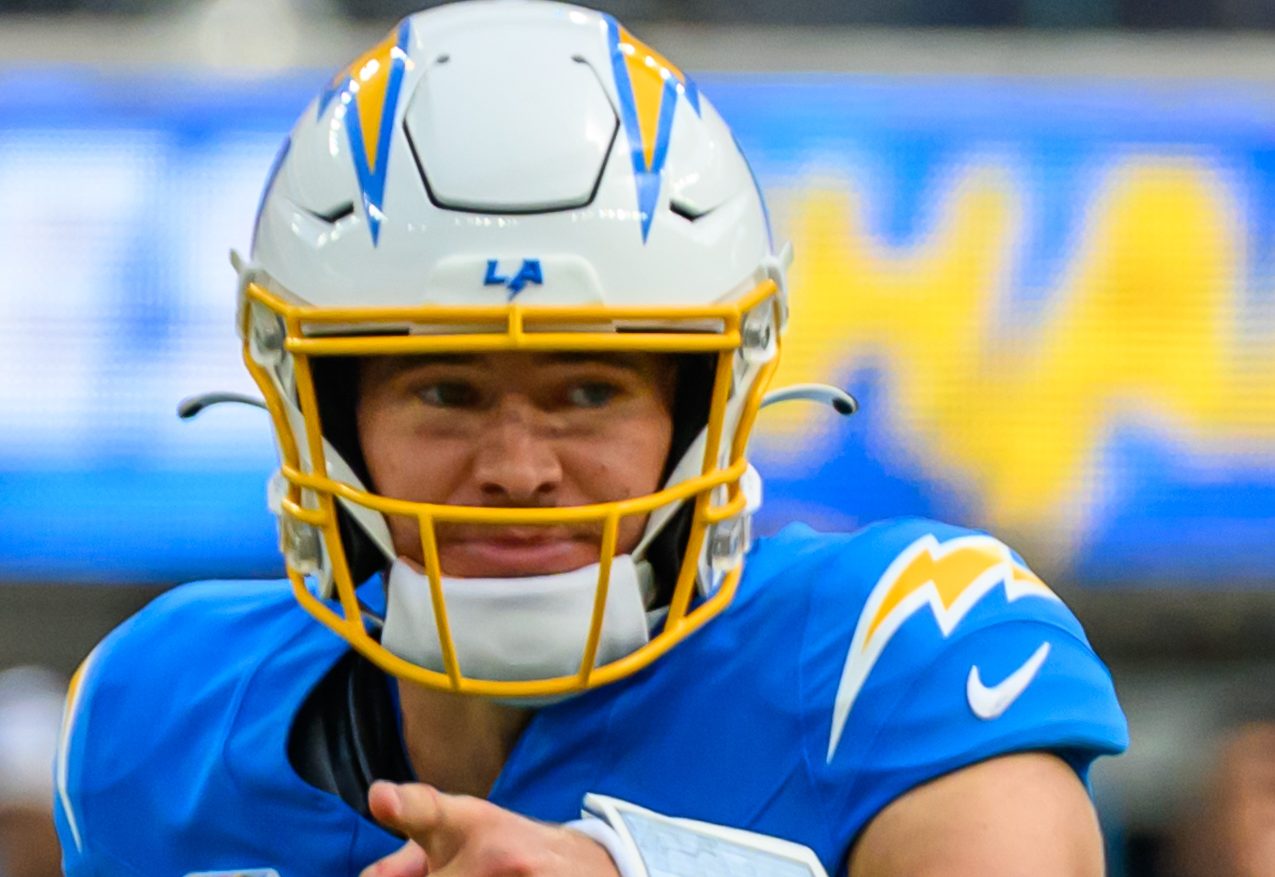
The Los Angeles Chargers selected Herbert with the No. 6 pick in the 2020 NFL Draft. He signed a four-year rookie deal worth about $26.6 million, fully guaranteed.
At first, he was expected to sit behind veteran Tyrod Taylor. That plan lasted one week.
Herbert’s first NFL start came in Week 2, when Taylor was ruled out shortly before kickoff after a team doctor accidentally punctured his lung while administering a painkiller injection. Herbert was suddenly in against the defending champion Patrick Mahomes and the Kansas City Chiefs. He threw a touchdown, ran for another and nearly pulled off the upset. The Chargers lost in overtime, but the bigger takeaway was obvious: they had found their quarterback.
A rookie season that changed the franchise’s timeline
Once Herbert got on the field, the numbers came fast.
He won AP NFL Offensive Rookie of the Year for the 2020 season after throwing for 4,336 yards and 31 touchdowns in 15 games. At the time, those 31 touchdown passes set the NFL rookie record, later broken by C.J. Stroud? No, that would be incorrect. The rookie touchdown-pass record was later broken by none through the period covered here; Herbert’s 31 remained the mark for a time before being tied or challenged, but in his rookie season it was the record. He also set rookie marks for completions (396) and 300-yard passing games (eight).
More important than any single record was the way he played. Herbert looked calm in crowded pockets, drove the ball outside the numbers, and handled volume without looking rushed by it. The arm strength was easy to see, but so was the poise. For a team that had entered the year planning for a transition, the transition ended almost immediately.
Early NFL seasons: big volume, bigger responsibility
Herbert followed that debut season with an even bigger statistical year in 2021. He threw for 5,014 yards and 38 touchdowns, becoming the first quarterback in Chargers history to top 5,000 passing yards in a season. He earned his first Pro Bowl nod and finished the year established as one of the league’s most productive passers.
By the end of his first two seasons, he had thrown for 9,350 yards and 69 touchdowns, both NFL records for a quarterback through two years at the time. He also became the first quarterback in league history to throw at least 30 touchdown passes in each of his first two seasons.
The style matched the output. Herbert could attack deep, but his game was never just about highlight throws. He won with rhythm, timing, velocity and a willingness to take what was there. At 6-foot-6 and around 236 pounds, he also brought more mobility than his frame suggested, especially as a runner outside structure.
The playoff loss that still follows him
Quarterbacks get attached to postseason results, fairly or not, and Herbert’s most discussed playoff game remains the one after the 2022 season.
In the AFC Wild Card round against Jacksonville, the Chargers raced to a 27-0 lead. Herbert threw for 273 yards and a touchdown, but Los Angeles did not score in the second half and lost 31-30. It became one of the largest comebacks in playoff history.
That result still sits awkwardly in his career file. It was a team collapse, not a one-man story, but franchise quarterbacks rarely get separated from games like that.
The contract that confirmed his place
By the summer of 2023, the Chargers no longer had to talk about Herbert as a rising player. He was their franchise centerpiece.
In July 2023, he signed a five-year extension worth $262.5 million, tying him to the club through the 2029 season. The deal included $218.7 million in guarantees, with $133.7 million guaranteed at signing, and briefly made him the highest-paid player in the NFL by average annual value at $52.5 million.
That contract did not create his status. It confirmed it.
Playing through injuries and adapting to change
Herbert’s career has not been a straight line of untouched production. He has played through significant pain before, including rib cartilage fractures in 2022, and he missed the end of the 2023 season after surgery on a fractured index finger on his throwing hand. Those stretches mattered because they showed another part of his profile: durability, toughness and a willingness to keep functioning when less than full strength.
When the Chargers changed coaching staffs, the demands around him changed too. Under Jim Harbaugh, the offense leaned into a more structured, balanced identity than the high-volume passing years that marked Herbert’s early seasons. That shift affected raw totals, but not his importance. The offense still ran through his decision-making, command at the line and ability to create efficient throws.
What kind of quarterback is Justin Herbert?
The simplest answer is that he is a modern franchise passer with old-school physical tools.
Herbert throws one of the stronger balls in the league, but arm talent alone does not explain his start. He processes quickly, stays composed under pressure and can make difficult throws without overplaying the position. He is also a better athlete than the classic pocket-quarterback label suggests. Designed runs are not the center of his game, yet he moves well enough to extend plays and pick up yards when defenses turn their backs.
For the Chargers, that blend has made him both the engine and the stabilizer.
Life away from football
Away from the field, Herbert has built a public image that is notably quiet for a star quarterback. He is not known for a loud celebrity profile, and most of what is firmly documented centers on family, charity work and selected business partnerships rather than private-life headlines.
His Oregon roots remain a constant part of the story. He has often been presented as close to his family, and that in-state path from Eugene to Oregon to the NFL still shapes how people see him.
His community work is easier to verify than most personal details. Herbert took part in a service trip to Uganda while at Oregon. In 2021, he donated $25,000 to the Los Angeles Regional Food Bank, helping provide 100,000 meals. Through the NFL’s My Cause My Cleats initiative, he has supported organizations including the Pediatric Cancer Research Foundation, Para Los Niños, Fuel Up to Play 60 and Beyond the Bell. He has also used brand partnerships to promote financial literacy.
Commercially, Herbert has been linked with major brands including Nike, Verizon, SoFi, Fanatics, Panini, Callaway Golf, TCL and Dr. Squatch. Some outlets have also connected him to other companies, but endorsement portfolios can shift, and not every reported partnership carries the same level of confirmation. Estimates of Justin Herbert net worth vary widely by source, which is typical for celebrity wealth reporting, so those figures are best treated as outside estimates rather than fixed fact.
His dating life is even less settled in the public record. Reports have linked him romantically to singer Madison Beer, and later reports claimed an engagement, but those claims should be treated as unconfirmed media reports rather than established fact unless Herbert or his representatives publicly confirm them.
Where his story stands
Herbert entered the league with questions about how quickly he would be ready. He answered them in a matter of weeks. Since then, he has piled up production, signed a franchise-quarterback contract and become the central figure in the Chargers’ plans.
The résumé still has one obvious gap: deep postseason success. Everything else, from the Oregon beginnings to the early NFL records, has already placed him among the most accomplished quarterbacks of his generation’s first wave.
FAQ
How tall is Justin Herbert?
He is listed at 6-foot-6.
What college did Justin Herbert attend?
He played at Oregon from 2016 through 2019.
When was Justin Herbert drafted?
The Chargers picked him No. 6 overall in the 2020 NFL Draft.
What is Justin Herbert’s contract?
He signed a five-year, $262.5 million extension with the Chargers in July 2023.
Is Justin Herbert married?
There is no confirmed public record establishing that he is married. Reports about his dating life and a possible engagement have circulated, but they remain unconfirmed.
What are Justin Herbert’s biggest early-career records?
He set NFL rookie records for touchdown passes and completions in 2020, and he opened his career with record-setting passing totals through his first two seasons.
Photo: All-Pro Reels, CC BY-SA 4.0, via Wikimedia Commons