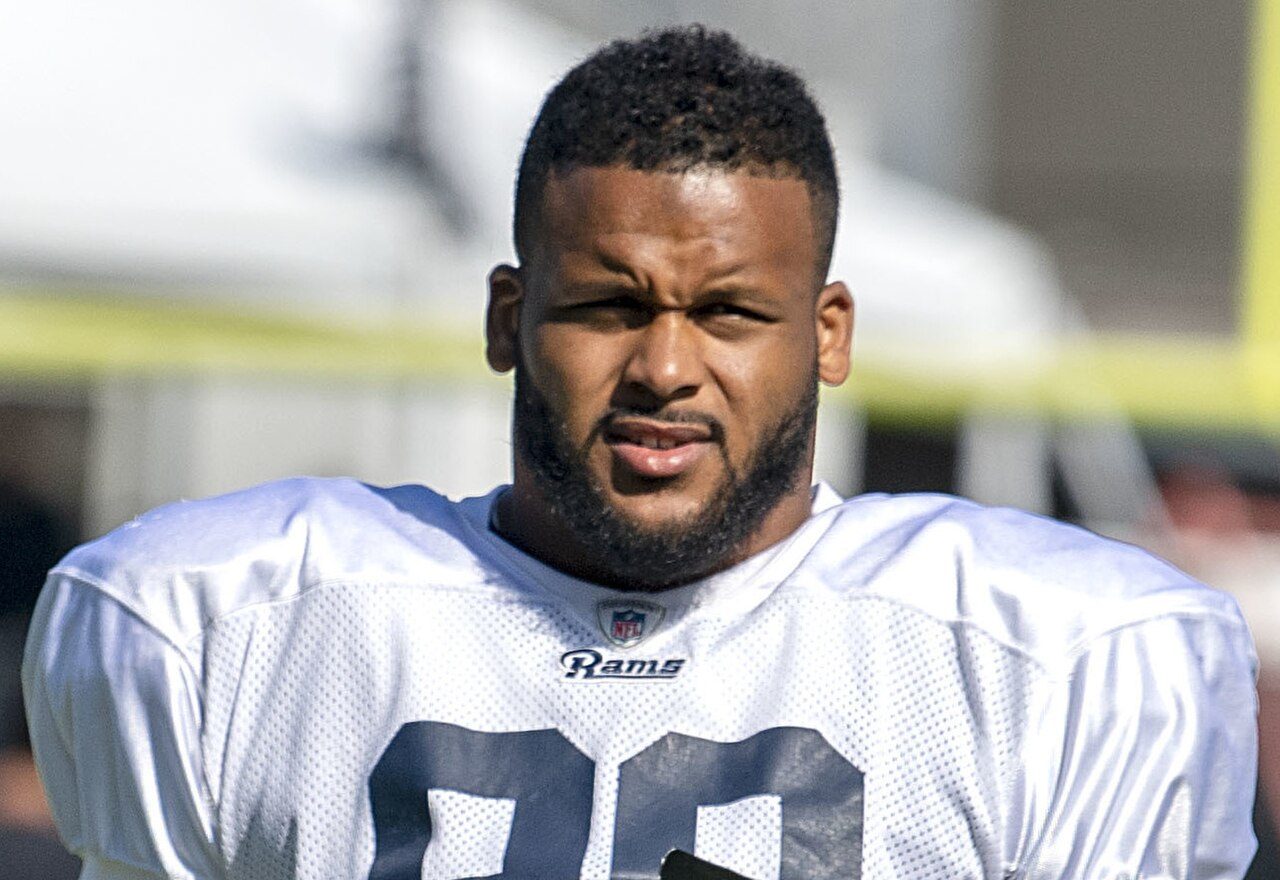
111 career sacks from an interior defensive lineman is the kind of number that stops you for a second. Aaron Donald did that from defensive tackle, won the NFL Defensive Player of the Year award three times, made the Pro Bowl in every season he played, and spent a full decade wrecking protection plans for the Rams before announcing his retirement on March 15, 2024.
Born Aaron Charles Donald on May 23, 1991, in Pittsburgh, Pennsylvania, he did not arrive in the NFL with the classic build teams once preferred inside. He was listed at 6-foot-1 and around 280 pounds, shorter and lighter than many tackles. What he had instead was rare: a first step that could beat a blocker before the rep had fully started, plus the balance, leverage and hand use to turn that quickness into damage.
Pittsburgh roots and the early routine
Donald grew up in Pittsburgh’s Lincoln-Lemington-Belmar area, the son of Archie Donald Sr. and Anita Goggins. He has a brother, Archie Jr., and a sister, Akita. The family story that follows him everywhere is not hard to understand. Around age 12, his father began pulling him into a strict workout routine, often starting at 4:30 in the morning in a home gym. Those sessions became part of the foundation of his career.
He later said he had been lazy as a kid before that structure took hold. The point matters, because Donald’s game never looked accidental. Even when he became one of the NFL’s most disruptive defenders, there was always a sense that the engine underneath it had been built long before the fame.
At Penn Hills High School, he played on both sides of the line and developed the low-center-of-gravity style that would later become his trademark. Recruiting services did not treat him like a can’t-miss national star. Rivals rated him a three-star prospect and the No. 37 defensive tackle in the country. That modest ranking now reads like a reminder of how often evaluators miss players who do not fit the usual template.
Staying home at Pitt, then exploding in 2013
Donald stayed close to home and enrolled at Pittsburgh, where he played from 2010 through 2013. His college career built in steps rather than one sudden leap. He became second-team All-Big East in 2011, then first-team All-Big East in 2012. By then, he was productive and respected. In 2013, he became unavoidable.
That final season at Pitt was one of the most decorated ever by a defensive player in the program. Donald won the Bronko Nagurski Trophy, Chuck Bednarik Award, Lombardi Award, Outland Trophy and Bill Willis Trophy. He was also a unanimous All-American, the ACC Defensive Player of the Year and a first-team All-ACC selection.
For an interior defender, that sweep said plenty. He was not just making tackles. He was blowing up plays before they formed, getting into backfields from angles offensive linemen rarely expect from a tackle, and forcing the sport to look at his position a little differently.
His ties to Pitt did not end when he left. He later made a seven-figure donation to the school, which led to the naming of the Aaron Donald Football Performance Center inside the Duratz Athletic Complex. Pitt also retired his No. 97 jersey, another sign of how fully he belongs to the program’s history.
The combine changed the conversation
Before the 2014 NFL Draft, Donald answered the size questions the way he often answered football questions: with production and testing that made the old doubts sound thin. At the NFL Scouting Combine, he ran the 40-yard dash in 4.68 seconds, the fastest time by a defensive tackle at that combine at the time.
That number did not make him a prospect on its own, but it sharpened the picture. He was undersized by traditional standards, yes, but also unusually explosive, agile and technically advanced. Teams had to decide whether they trusted the measurements or the tape. The Rams trusted the tape.
St. Louis selected him with the 13th overall pick in the first round of the 2014 draft. He signed his rookie contract that June: four years, $10.13 million, fully guaranteed, with a signing bonus of roughly $5.69 million.
A rookie season that started a 10-year run
Donald made an impact immediately. In 2014, his first NFL season, he won AP Defensive Rookie of the Year and landed on the PFWA All-Rookie Team. That was the start of a streak that became one of the cleanest markers of his consistency: 10 seasons played, 10 Pro Bowl selections.
The Rams franchise moved from St. Louis to Los Angeles during his career, but Donald remained the constant. He wore No. 99 the whole way, and year after year he was the player offenses had to identify first.
His All-Pro record tells the same story. Donald earned first-team All-Pro honors eight times: 2015, 2016, 2017, 2018, 2019, 2020, 2021 and 2023. He was second-team All-Pro in 2014 and 2022. There were no wasted seasons in the middle of his prime.
The peak years and the 20.5-sack season
By 2017, Donald had moved from elite player to annual measuring stick. He won AP NFL Defensive Player of the Year that season, then won it again in 2018 and 2020. Only Lawrence Taylor and J.J. Watt had also claimed that award three times.
The 2018 season remains the statistical peak. Donald recorded 20.5 sacks, a staggering total for any defender and especially for one lining up inside. He also won the Deacon Jones Award that year. Interior pressure has always been the quickest way to break an offense, and Donald delivered it at a level few players in league history have matched.
That same year, on August 31, 2018, the Rams signed him to a six-year, $135 million extension with $87 million guaranteed. At the time, it made him the highest-paid defensive player in the NFL. The contract reflected more than production. It reflected scarcity. There simply were not other players doing his job that way.
By the end of his career, Donald’s regular-season totals stood at 543 tackles, 176 tackles for loss, 111 sacks, 24 forced fumbles, 7 fumble recoveries and 21 passes defended. His 111 sacks are the Rams’ franchise record.
Two Super Bowls, one title, one final pressure
Donald reached the Super Bowl twice with the Rams. The first trip came after the 2018 season, when Los Angeles lost Super Bowl LIII to New England. The second ended the way every contender wants it to.
In the 2021 season, the Rams won Super Bowl LVI on their home field. Donald did not need a gaudy stat line in the final moments to leave the image people remember. On Cincinnati’s last offensive snap, he beat his man, closed on Joe Burrow and forced the hurried incompletion that sealed the championship.
It was a fitting finish to the biggest game of his career: pressure up the middle, the pocket collapsing, the quarterback with nowhere comfortable to go.
Why Aaron Donald was so hard to block
Donald was never a classic space-eating defensive tackle. He could hold up against the run, but that label misses what made him special. His game was built on get-off, leverage, violent hands and the ability to turn speed into power almost instantly.
Because he played lower than most blockers, he could win the leverage battle before contact fully settled. Because he was so explosive, guards and centers often felt rushed into bad technique. And because he had the strength to finish, quick wins did not just create pressure; they often ended in sacks, tackles for loss or a play wrecked before it had a chance.
Offenses treated him accordingly, sliding protection his way and sending extra attention inside. It often did not matter. Donald still produced like an edge rusher while lining up in the middle of the formation, which is a large part of why his résumé stands apart.
His honors beyond the yearly awards underline that place in the era. He was a unanimous choice for the NFL 2010s All-Decade Team and became a fixture in the Madden NFL “99 Club,” reaching it a record seven times.
Life away from the field
Even after fame, Donald’s public story kept circling back to Pittsburgh and discipline. The basement workouts with his father became part of his biography because they explain something real about him. So does his continued connection to Pitt, where his donation helped fund player development long after his own college days were over.
In 2019, he launched the AD99 Solutions Foundation, focused on helping underserved youth through education, enrichment and community support. The name comes from his jersey number, but the idea tracks with the structure that shaped his own path.
In his private life, Donald married Erica Sherman in 2022. Beyond that, it is best to keep the focus where the public record is strongest: family, community work and a career that was unusually well documented on the field.
As for comeback talk, that should be labeled carefully. After his retirement, there was occasional speculation in media coverage about whether he might consider returning. Those reports were only speculation, not a confirmed comeback plan, and he retired as an active player on March 15, 2024.
FAQ
When did Aaron Donald retire?
He announced his retirement on March 15, 2024.
What team did Aaron Donald play for?
He played his entire NFL career with the Rams franchise, from St. Louis to Los Angeles, from 2014 through 2023.
How many sacks did Aaron Donald have?
He finished with 111 career regular-season sacks.
How many Super Bowls did Aaron Donald win?
He won one, Super Bowl LVI with the Rams.
What college did Aaron Donald attend?
He played college football at the University of Pittsburgh.
What number did Aaron Donald wear?
He wore No. 99 throughout his NFL career.
Photo: The 621st Contingency Response Wing, CC BY 2.0, via Wikimedia Commons